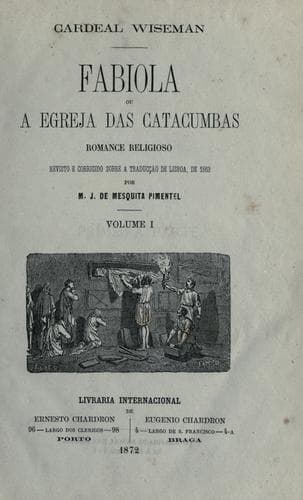
Fabiola; Or, The Church of the CatacombsWiseman, Nicholas Patrick
HistoryHistory
Fabiola; Or, The Church of the Catacombs
Wiseman, Nicholas Patrick
Christian fiction; Church history -- Primitive and early church, ca. 30-600 -- Fiction; Historical fiction
“How kind of her; yet how much kinder of you, my sister! But why have
you not partaken of it yourself? It was meant for you and not for me.”
“Why, to tell the truth, it is a greater treat to me, to see you enjoy
any thing, than to enjoy it myself.”
“No, dear Syra, no; it must not be. God has wished me to be poor, and I
must try to do His will. I could no more think of eating the food, than
I could of wearing the dress, of the rich, so long as I can obtain that
of the poor. I love to share with you your _pulmentum_,[30] which I know
is given me in charity by one poor like myself. I procure for you the
merit of alms-deeds; you give me the consolation of feeling that I am,
before God, still only a poor blind thing. I think He will love me
better thus, than if feeding on luxurious fare. I would rather be with
Lazarus at the gate, than with Dives at the table.”
“How much better and wiser you are than I, my good child! It shall be as
you wish. I will give the dish to my companions, and, in the meantime,
here I set before you your usual humble fare.”
“Thanks, thanks, dear sister; I will await your return.”
Syra went to the maids’ apartment, and put before her jealous but greedy
companions the silver dish. As their mistress occasionally showed them
this little kindness, it did not much surprise them. But the poor
servant was weak enough to feel ashamed of appearing before her comrades
with the rich scarf round her arm. She took it off before she entered;
then, not wishing to displease Euphrosyne, replaced it as well as she
could with one hand, on coming out. She was in the court below,
returning to her blind friend, when she saw one of the noble guests of
her mistress’s table alone, and, with a mortified look, crossing towards
the door, and she stepped behind a column to avoid any possible, and not
uncommon, rudeness. It was Fulvius; and no sooner did she, unseen, catch
a glimpse of him, than she stood for a moment as one nailed to the spot.
Her heart beat against her bosom, then quivered as if about to cease its
action; her knees struck against one another, a shiver ran through her
frame, while perspiration started on her brow. Her eyes, wide open, were
fascinated, like the bird’s before the snake. She raised her hand to her
breast, made upon it the sign of life, and the spell was broken. She
fled in an instant, still unnoticed, and had hardly stepped noiselessly
behind a curtain that closed the stairs, when Fulvius, with downcast
eyes, reached the spot on which she had stood. He started back a step,
as if scared by something lying before him. He trembled violently; but
recovering himself by a sudden effort, he looked around him and saw that
he was alone. There was no eye upon him--except One which he did not
heed, but which read his evil heart in that hour. He gazed again upon
the object, and stooped to pick it up, but drew back his hand, and that
more than once. At last he heard footsteps approaching, he recognized
Public-domain text, read in full here on John Shaqi.
Reviews
Reviews
No reviews yet
Be the first to share your thoughts on this work.
Join the Discussion
Join the discussion
Sign in to leave a comment or review.
Sign InorCreate an account