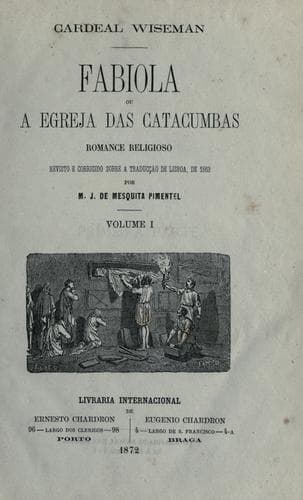
Fabiola; Or, The Church of the CatacombsWiseman, Nicholas Patrick
HistoryHistory
Fabiola; Or, The Church of the Catacombs
Wiseman, Nicholas Patrick
Christian fiction; Church history -- Primitive and early church, ca. 30-600 -- Fiction; Historical fiction
Sebastian, enjoying the unbounded confidence of the emperor, employed
all his influence in propagating the Christian faith within the palace.
Numerous conversions had gradually been made; but shortly before this
period there had been a wholesale one effected, the particulars of which
are recorded in the genuine Acts of this glorious soldier. In virtue of
former laws, many Christians were seized and brought to trial, which
often ended in death. Two brothers, Marcus and Marcellianus, had been so
accused, and were expecting execution; when their friends, admitted to
see them, implored them with tears to save their lives by apostasy. They
seemed to waver; they promised to deliberate. Sebastian heard of this,
and rushed to save them. He was too well known to be refused
admittance, and he entered into their gloomy prison like an angel of
light. It consisted of a strong room in the house of the magistrate to
whose care they had been intrusted. The place of confinement was
generally left to that officer; and here Tranquillinus, the father of
the two youths, had obtained a respite for them of thirty days to try to
shake their constancy; and, to second his efforts, Nicostratus, the
magistrate, had placed them in custody in his own house. Sebastian’s was
a bold and perilous office. Besides the two Christian captives, there
were gathered in the place sixteen heathen prisoners; there were the
parents of the unfortunate youths weeping over them, and caressing them,
to allure them from their threatened doom; there was the gaoler,
Claudius, and there was the magistrate, Nicostratus, with his wife, Zoë,
drawn thither by the compassionate wish of seeing the youths snatched
from their fate. Could Sebastian hope, that of this crowd not one would
be found, whom a sense of official duty, or a hope of pardon, or hatred
of Christianity, might impel to betray him, if he avowed himself a
Christian? And did he not know that such a betrayal involved his death?
[Illustration: Saint Sebastian, from the “Roma Sotteranea” of De Rossi.]
Public-domain text, read in full here on John Shaqi.
Reviews
Reviews
No reviews yet
Be the first to share your thoughts on this work.
Elsewhere in the archive
Join the Discussion
Join the discussion
Sign in to leave a comment or review.
Sign InorCreate an account