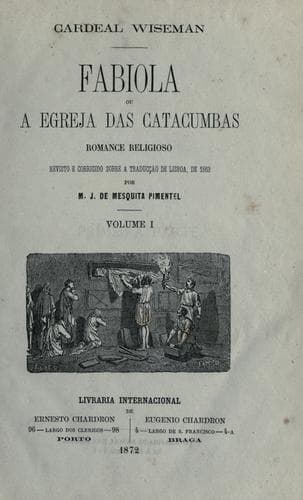
Fabiola; Or, The Church of the CatacombsWiseman, Nicholas Patrick
HistoryHistory
Fabiola; Or, The Church of the Catacombs
Wiseman, Nicholas Patrick
Christian fiction; Church history -- Primitive and early church, ca. 30-600 -- Fiction; Historical fiction
The victory was complete. Every one was gained; and immediate steps were
taken to prevent discovery. The person responsible for the prisoners
could take them where he wished; and Nicostratus transferred them all,
with Tranquillinus and his wife, to the full liberty of his house.
Sebastian lost no time in putting them under the care of the holy priest
Polycarp, of the title of St. Pastor. It was a case so peculiar, and
requiring such concealment, and the times were so threatening, and all
new irritations had so much to be avoided, that the instruction was
hurried, and continued night and day: so that baptism was quickly
administered.
The new Christian flock was encouraged and consoled by a fresh wonder.
Tranquillinus, who was suffering severely from the gout, was restored to
instant and complete health by baptism. Chromatius was the prefect of
the city, to whom Nicostratus was liable for his prisoners; and this
officer could not long conceal from him what had happened. It was indeed
a matter of life or death to them all; but, strengthened now by faith,
they were prepared for either. Chromatius was a man of upright
character, and not fond of persecution; and listened with interest to
the account of what had occurred. But when he heard of Tranquillinus’s
cure, he was greatly struck. He was himself a victim to the same
disease, and suffered agonies of pain. “If,” he said, “what you relate
be true, and if I can have personal experience of this healing power, I
certainly will not resist its evidence.”
Sebastian was sent for. To have administered baptism without faith
preceding, as an experiment of its healing virtue, would have been a
superstition. Sebastian took another course, which will be later
described, and Chromatius completely recovered. He received baptism soon
after, with his son Tibertius.
It was clearly impossible for him to continue in his office, and he had
accordingly resigned it to the emperor. Tertullus, the father of the
hopeful Corvinus, and prefect of the Prætorium, had been named his
successor; so the reader will perceive that the events just related from
the Acts of St. Sebastian, had occurred a little before our narrative
begins; for in an early chapter we spoke of Corvinus’s father as already
prefect of the city.
Public-domain text, read in full here on John Shaqi.
Reviews
Reviews
No reviews yet
Be the first to share your thoughts on this work.
Elsewhere in the archive
Join the Discussion
Join the discussion
Sign in to leave a comment or review.
Sign InorCreate an account