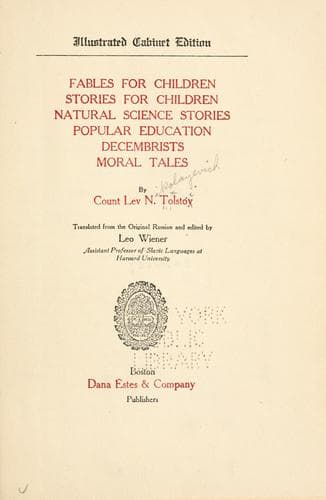
Fables for Children, Stories for Children, Natural Science Stories, Popular Education, Decembrists, Moral TalesTolstoy, Leo, graf
General
Fables for Children, Stories for Children, Natural Science Stories, Popular Education, Decembrists, Moral Tales
Tolstoy, Leo, graf
Russian literature -- Translations into English
He came out with 250 roubles less, but was dressed badly, in fact so
badly that his apparel two days later passed over into Vasíli's
possession and always remained a disagreeable memory for Serézha.
At home he went down-stairs, seated himself in the large hall, looking
now and then into the sanctum, and ordered a breakfast of such strange
dishes that the servant in the kitchen had to laugh. Then he asked for
a periodical, and pretended to be reading. When the servant, encouraged
by the inexperience of the young man, addressed some questions to him,
Serézha said, "Go to your place!" and blushed. But he said this so
proudly that the servant obeyed. Mother, father, and daughter, upon
returning home, found his clothes excellent.
Do you remember that joyous sensation of childhood, when you were
dressed up for your name-day and taken to mass, and when, upon returning
with a holiday expression in your clothes, upon your countenance, and in
your soul, you found toys and guests at home? You knew that on that day
there would be no classes, that even the grown-ups celebrated on that
day, and that that was a day of exceptions and pleasures for the whole
house; you knew that you alone were the cause of that holiday, and that
you would be forgiven, no matter what you might do, and you were
surprised to see that the people in the streets did not celebrate along
with your home folk, and the sounds were more audible, and the colours
brighter,--in short, a name-day sensation. It was a sensation of that
kind that Peter Ivánovich experienced on his return from church.
Pákhtin's solicitude of the evening before did not pass in vain: instead
of toys Peter Ivánovich found at home several visiting-cards of
distinguished Muscovites, who, in the year '56, regarded it as their
peremptory duty to show every attention possible to a famous exile, whom
they would under no consideration have wished to see three years before.
In the eyes of Chevalier, the porter, and the servants of the hotel, the
appearance of carriages asking for Peter Ivánovich, on that one morning
increased their respect and subserviency tenfold.
All those were name-day toys for Peter Ivánovich. No matter how much
tried in life, how clever a man may be, the expression of respect from
people respected by a large number of men is always agreeable. Peter
Ivánovich felt light of heart when Chevalier, bowing, offered to change
his apartments and asked him to order anything he might need, and
assured him that he regarded Peter Ivánovich's visit as a piece of luck,
and when, examining the visiting-cards and throwing them into a vase, he
called out the names of Count S----, Prince D----, and so forth.
Natálya Nikoláevna said that she would not receive anybody and that she
would go at once to the house of Márya Ivánovna, to which Peter
Ivánovich consented, though he wished very much to talk to some of the
visitors.
Public-domain text, read in full here on John Shaqi.
Reviews
Reviews
No reviews yet
Be the first to share your thoughts on this work.
Elsewhere in the archive
Join the Discussion
Join the discussion
Sign in to leave a comment or review.
Sign InorCreate an account