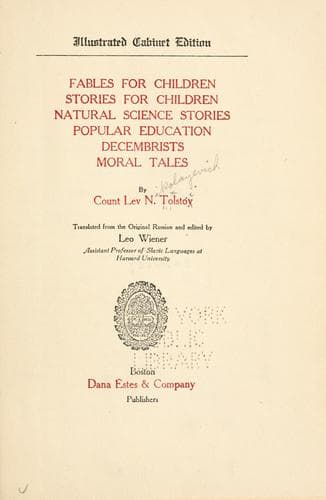
Fables for Children, Stories for Children, Natural Science Stories, Popular Education, Decembrists, Moral TalesTolstoy, Leo, graf
General
Fables for Children, Stories for Children, Natural Science Stories, Popular Education, Decembrists, Moral Tales
Tolstoy, Leo, graf
Russian literature -- Translations into English
At the table sat the vicar of Moscow, Madame Byéshev, and Skópin. Márya
Ivánovna was telling them about young Count V----, the son of P----
Z----, who had returned from Sevastopol, and with whom she was in love.
(She had some passion all the time.) He was to dine with her on that
day. The vicar got up and bowed himself out. Márya Ivánovna did not keep
him,--she was a freethinker in this respect: she was pious, but had no
use for monks and laughed at the ladies that ran after them, and boldly
asserted that in her opinion monks were just such men as we sinful
people, and that it was better to find salvation in the world than in a
monastery.
"Give the order not to receive anybody, my dear," she said, "I will
write to Pierre. I cannot understand why he is not coming. No doubt,
Natálya Nikoláevna is ill."
Márya Ivánovna was of the opinion that Natálya Nikoláevna did not like
her and was her enemy. She could not forgive her because it was not she,
his sister, who had given up her property and had followed him to
Siberia, but Natálya Nikoláevna, and because her brother had definitely
declined her offer when she got ready to go with him. After thirty-five
years she was beginning to believe that Natálya Nikoláevna was the best
woman in the world and his guardian angel; but she was envious, and it
seemed all the time to her that she was not a good woman.
She got up, took a few steps in the parlour, and was on the point of
entering the cabinet when the door opened, and Madame Byéshev's
wrinkled, grayish face, expressing joyous terror, was thrust through the
door.
"Márya Ivánovna, prepare yourself," she said.
"A letter?"
"No, something better--"
But before she had a chance to finish, a man's loud voice was heard in
the antechamber:
"Where is she? Go, Natásha."
"He!" muttered Márya Ivánovna, walking with long, firm steps toward her
brother. She met them all as though she had last seen them the day
before.
"When didst thou arrive? Where have you stopped? How have you come,--in
a carriage?" Such were the questions which Márya Ivánovna put, walking
with them to the drawing-room and not hearing the answers, and looking
with large eyes, now upon one, and now upon another. Madame Byéshev was
surprised at this calm, even indifference, and did not approve of it.
They all smiled; the conversation died down, and Márya Ivánovna looked
silently and seriously at her brother.
"How are you?" asked Peter Ivánovich, taking her hand, and smiling.
Peter Ivánovich said "you" to her, though she had said "thou." Márya
Ivánovna once more looked at his gray beard, his bald head, his teeth,
his wrinkles, his eyes, his sunburnt face, and recognized all that.
"Here is my Sónya."
But she did not look around.
Public-domain text, read in full here on John Shaqi.
Reviews
Reviews
No reviews yet
Be the first to share your thoughts on this work.
Elsewhere in the archive
Join the Discussion
Join the discussion
Sign in to leave a comment or review.
Sign InorCreate an account