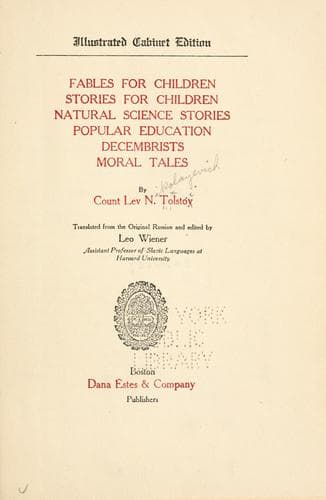
Fables for Children, Stories for Children, Natural Science Stories, Popular Education, Decembrists, Moral TalesTolstoy, Leo, graf
General
Fables for Children, Stories for Children, Natural Science Stories, Popular Education, Decembrists, Moral Tales
Tolstoy, Leo, graf
Russian literature -- Translations into English
which hung a new scarf with red edges, was praying so fervently,
solemnly, and impassionately that one could not fail directing one's
attention to her.
Before reaching the elder, who, standing at the little safe, was
kneading over the remnants of some tapers into one piece of wax, Iván
Petróvich stopped to take a look at the praying woman. The old woman was
praying well. She knelt as straight as it was possible to kneel in front
of the image; all the members of her body were mathematically
symmetrical; her feet behind her pressed with the tips of her bast shoes
at the same angle against the stone floor; her body was bent back, to
the extent to which her stooping shoulders permitted her to do so; her
hands were quite regularly placed below her abdomen; her head was thrown
back, and her face, with an expression of bashful commiseration,
wrinkled, and with a dim glance, was turned straight toward the image
with the scarf. Having remained in an immobile position for a minute or
less,--evidently a definite space of time,--she heaved a deep sigh and,
taking her right hand away, swung it above her head-gear, touched the
crown of her head with folded fingers, and made ample crosses by
carrying her hand down again to her abdomen and to her shoulders; then
she swayed back and dropped her head on her hands, which were placed
evenly on the floor, and again raised herself, and repeated the same.
"Now she is praying," Iván Petróvich thought, as he looked at her. "She
does it differently from us sinners: this is faith, though I know that
she is praying to her own image, or to her scarf, or to her adornment on
the image, just like the rest of them. All right. What of it?" he said
to himself, "every person has his own faith: she prays to her image, and
I consider it necessary to beg the peasant's forgiveness."
And he walked over to the elder, instinctively scrutinizing the church
in order to see who was going to see his deed, which both pleased and
shamed him. It was disagreeable to him, because the old beggar women
would see it, and more disagreeable still, because Míshka, his lackey,
would see it. In the presence of Míshka,--he knew how wide-awake and
shrewd he was,--he felt that he should not have the strength to walk up
to Iván Fedótov. He beckoned to Míshka to come up to him.
"What is it you wish?"
"Go, my dear, and bring me the rug from the carriage, for it is too damp
here for my feet."
"Yes, sir."
When Míshka went away, Iván Petróvich at once went up to Iván Fedótov.
Iván Fedótov was disconcerted, like a guilty person, at the approach of
the gentleman. Timidity and hasty motions formed a queer contradiction
to his austere face and curly steel-gray hair and beard.
"Do you wish a dime taper?" he said, raising the desk, and now and then
casting his large, beautiful eyes upon the master.
Public-domain text, read in full here on John Shaqi.
Reviews
Reviews
No reviews yet
Be the first to share your thoughts on this work.
Elsewhere in the archive
Join the Discussion
Join the discussion
Sign in to leave a comment or review.
Sign InorCreate an account