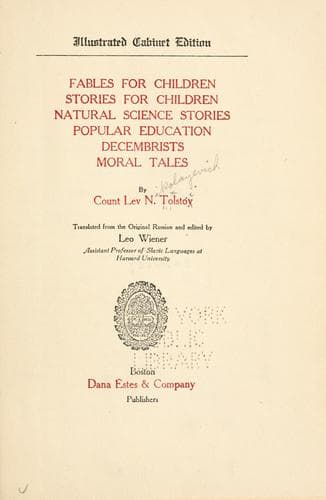
Fables for Children, Stories for Children, Natural Science Stories, Popular Education, Decembrists, Moral TalesTolstoy, Leo, graf
General
Fables for Children, Stories for Children, Natural Science Stories, Popular Education, Decembrists, Moral Tales
Tolstoy, Leo, graf
Russian literature -- Translations into English
After that, Prince Chernýshev, with his good-natured and merry
carelessness, entirely acquiesced, the more so since he knew full well
that he had not "appropriated" any land of the peasants, as was said in
the petition of the peasants. If the land was "appropriated," his father
had done it, and since then more than forty years had passed. He knew
that the peasants of the village of Izlegóshcha were getting along well
without that land, had no need of it, and lived on terms of friendship
with him, and was unable to understand why they had become so infuriated
against him. He knew that he never offended and never wished to offend
any one, that he lived in peace with everybody, and that he never wished
to do otherwise, and so could not believe that any one should think of
offending him. He hated litigations, and so did not defend his case in
the Senate, in spite of the advice and earnest solicitations of his
lawyer, Ilyá Mitrofánov; by allowing the time for the appeal to lapse,
he lost the case in the Senate, and lost it in such a way that he was
confronted with complete ruin. By the decree of the Senate he not only
was to be deprived of five thousand desyatínas of land, but also, for
the illegal tenure of that land, was to be mulcted to the amount of
107,000 roubles in favour of the peasants.
Prince Chernýshev had eight thousand souls, but all the estates were
mortgaged and he had large debts, so that this decree of the Senate
ruined him with his whole large family. He had a son and five daughters.
He thought of his case when it was too late to attend to it in the
Senate. According to Ilyá Mitrofánov's words there was but one
salvation, and that was, to petition the sovereign and to transfer the
case to the Imperial Council. To obtain this it was necessary in person
to approach one of the ministers or a member of the Council, or, better
still, the emperor himself. Taking all that into consideration, Prince
Grigóri Ivánovich in the fall of the year 1817 with his whole family
left his beloved estate of Studénets, where he had lived so long without
leaving it, and went to Moscow. He started for Moscow, and not for St.
Petersburg, because in the fall of that year the emperor with his whole
court, with all the highest dignitaries, and with part of the Guards, in
which the son of Grigóri Ivánovich was serving, was to arrive in Moscow
to lay the corner-stone of the Church of the Saviour in commemoration
of the liberation of Russia from the French invasion.
Public-domain text, read in full here on John Shaqi.
Reviews
Reviews
No reviews yet
Be the first to share your thoughts on this work.
Elsewhere in the archive
Join the Discussion
Join the discussion
Sign in to leave a comment or review.
Sign InorCreate an account