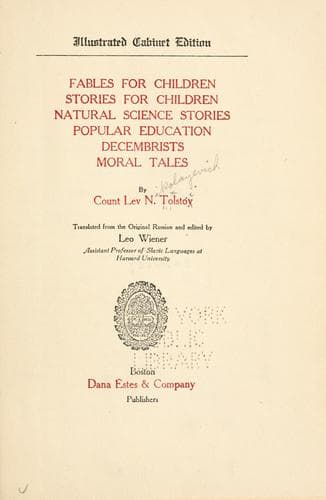
Fables for Children, Stories for Children, Natural Science Stories, Popular Education, Decembrists, Moral TalesTolstoy, Leo, graf
General
Fables for Children, Stories for Children, Natural Science Stories, Popular Education, Decembrists, Moral Tales
Tolstoy, Leo, graf
Russian literature -- Translations into English
As I wish to remain true to my rule that criticism should point out how
that which is not good ought to be, I shall try to show how the whole
school business ought to be arranged, if it is not to be a plaything,
and is to have a future. The answer is the same as to the first two
questions,--freedom. The masses must be given the freedom to arrange
their schools as they wish, and as little as possible should any one
interfere in their arrangement. Only with such a view of the matter will
all the obstacles to the dissemination of the schools be obviated,
though they have seemed insuperable. The chief obstacles are the
insufficiency of the means and the impossibility of increasing them. To
the first the masses reply that they are using all the measures at
their command to make the schools cost little; to the second they reply
that the means will always be found so long as they themselves are the
masters, and that they are not willing to increase the means for the
support of that which they do not need.
The essential difference between the view of the people and of the
ministerial department consists in the following: (1) In the opinion of
the masses there is no one definite norm and form of the school, outside
and below which the school is not recognized, as is assumed by the
ministerial department; a school may be of any kind, either a very good
and expensive one, or a very poor and cheap one, but even in a very poor
one reading and writing may be learned, and, as in a richer parish a
better pope is appointed and a better church built, so also may a better
school be built in a wealthy village, and a poorer school in a less
well-to-do village; but just as one can pray equally well in a poor or
in a rich parish, even so it is with learning. (2) The masses regard as
the first condition of their education an even, equal distribution of
this education, though it be in its lowest stage, and then only they
propose a further, again an even, raising of the level of education,
while the ministerial department considers it necessary to give to a
certain chosen few, to one-twentieth of the whole number, a specimen of
education, to show them how nice it is. (3) The ministerial department,
either unable or purposely unwilling to calculate, has raised the
educational business to such a high, expensive level, and one which is
so foreign to the masses, that considering the high price at which the
education is acquired, no issue from that situation can be foreseen, and
the number of learners can never be increased; but the masses, who know
how to calculate, and who are interested in that calculation, have no
doubt long ago figured out what I have pointed out above, and see as
clear as daylight that those expensive schools, which cost as much as
four hundred roubles each, may be good indeed, but are not what they
need, and try in every way possible to diminish the expenses for their
schools.
Public-domain text, read in full here on John Shaqi.
Reviews
Reviews
No reviews yet
Be the first to share your thoughts on this work.
Elsewhere in the archive
Join the Discussion
Join the discussion
Sign in to leave a comment or review.
Sign InorCreate an account