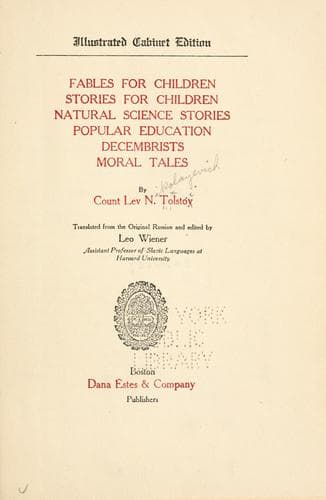
Fables for Children, Stories for Children, Natural Science Stories, Popular Education, Decembrists, Moral TalesTolstoy, Leo, graf
General
Fables for Children, Stories for Children, Natural Science Stories, Popular Education, Decembrists, Moral Tales
Tolstoy, Leo, graf
Russian literature -- Translations into English
"Good day, what do you wish?"
"The lady has sent me about the boots."
"What about the boots?"
"What about the boots? Our master does not need them. Our master has bid
us live long."
"You don't say!"
"He had not yet reached home, when he died in his carriage. The carriage
drove up to the house, and the servants came to help him out, but he lay
as heavy as a bag, and was stiff and dead, and they had a hard time
taking him out from the carriage. So the lady has sent me, saying: 'Tell
the shoemaker that a gentleman came to see him, and ordered a pair of
boots, and left the material for them; well, tell him that the boots are
not wanted, but that he should use the leather at once for a pair of
soft shoes. Wait until they make them, and bring them with you.' And so
that is why I have come."
Mikháyla took the remnants of the material from the table, rolled them
up, and took the soft shoes which he had made, and clapped them against
each other, and wiped them off with his apron, and gave them to the lad.
The lad took the soft shoes.
"Good-bye, masters, good luck to you!"
VIII.
There passed another year, and a third, and Mikháyla was now living the
sixth year with Semén. He was living as before. He went nowhere, did not
speak an unnecessary word, and all that time had smiled but twice: once,
when they gave him the supper, and the second time when the gentleman
came. Semén did not get tired admiring his workman. He no longer asked
him where he came from; he was only afraid that Mikháyla might leave
him.
One day they were sitting at home. The housewife was putting the iron
pots into the oven, and the children were running on the benches, and
looking out of the window. Semén was sharpening his knives at one
window, and Mikháyla was heeling a shoe at the other.
One of the little boys ran up to Mikháyla on the bench, leaned against
his shoulder, and looked out of the window.
"Uncle Mikháyla, look there: a merchant woman is coming to us with some
little girls. One of the girls is lame."
When the boy said that, Mikháyla threw down his work, turned to the
window, and looked out into the street.
And Semén marvelled. Mikháyla had never before looked into the street,
and now he had rushed to the window, and was gazing at something. Semén,
too, looked out of the window: he saw, indeed, a woman who was walking
over to his yard. She was well dressed, and led two little girls in fur
coats and shawls. The girls looked one like the other, so that it was
hard to tell them apart, only one had a maimed left leg,--she walked
with a limp.
The woman walked up the porch to the vestibule, felt for the entrance,
pulled at the latch, and opened the door. First she let the two girls
in, and then entered herself.
"Good day, people!"
"You are welcome! What do you wish?"
The woman seated herself at the table. The girls pressed close to her
knees: they were timid before the people.
"I want you to make some leather boots for the girls for the spring."
Public-domain text, read in full here on John Shaqi.
Reviews
Reviews
No reviews yet
Be the first to share your thoughts on this work.
Elsewhere in the archive
Join the Discussion
Join the discussion
Sign in to leave a comment or review.
Sign InorCreate an account