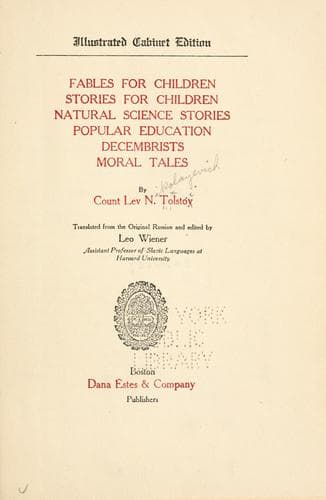
Fables for Children, Stories for Children, Natural Science Stories, Popular Education, Decembrists, Moral TalesTolstoy, Leo, graf
General
Fables for Children, Stories for Children, Natural Science Stories, Popular Education, Decembrists, Moral Tales
Tolstoy, Leo, graf
Russian literature -- Translations into English
"I went in the morning to see my neighbour, but she, the dear woman, was
already cold. As she died she fell on the girl, and wrenched her leg.
The people came, and they washed and dressed her, and made a coffin, and
buried her. All of them were good people. The girls were left alone.
What was to be done with them? Of all the women I alone had a baby. I
had been nursing my first-born boy for eight weeks. I took them for the
time being to my house. The peasants gathered and thought and thought
what to do with them, and they said to me: 'Márya, keep the girls
awhile, and we will try and think what to do with them.' And I nursed
the straight girl once, but the lame girl I would not nurse. I did not
want her to live. But, I thought, why should the angelic soul go out,
and so I pitied her, too. I began to nurse her, and so I raised my own
and the two girls, all three of them with my own breasts. I was young
and strong, and I had good food. And God gave me so much milk in my
breasts that at times they overflowed. I would feed two of them, while
the third would be waiting. When one rolled away, I took the third. And
God granted that I should raise the three, but my own child I lost in
the second year. And God has given me no other children. We began to
earn more and more, and now we are living here with the merchant at the
mill. The wages are big, and our living is good. I have no children, and
how should I live if it were not for these girls? How can I help loving
them? They are all the wax of my tapers that I have."
With one hand the woman pressed the lame girl to her side, and with the
other she began to wipe off her tears.
And Matréna sighed, and said:
"Not in vain is the proverb: 'You can live without parents, but not
without God.'"
And so they were talking among themselves, when suddenly the room was
lighted as though by sheet lightning from the corner where sat Mikháyla.
All looked at him, and they saw Mikháyla sitting with folded hands on
his knees, and looking up, and smiling.
X.
The woman went away with the girls, and Mikháyla got up from his bench.
He lay down his work, took off his apron, bowed to the master and to the
housewife, and said:
"Forgive me, people! God has forgiven me. You, too, should forgive me."
And the master and his wife saw a light coming from Mikháyla. And Semén
got up, and bowed to Mikháyla, and said:
"I see, Mikháyla, you are not a simple man, and I cannot keep you, and
must not beg you to remain. But tell me this: Why, when I found you and
brought you home, were you gloomy, and when my wife gave you a supper,
why did you smile at her and after that grow brighter? Later, when the
gentleman ordered the boots, you smiled for the second time, and after
that grew brighter, and now, when the woman brought her girls, you
smiled for the third time, and grew entirely bright. Tell me, Mikháyla,
why does such light come from you, and why did you smile three times?"
And Mikháyla said:
Public-domain text, read in full here on John Shaqi.
Reviews
Reviews
No reviews yet
Be the first to share your thoughts on this work.
Elsewhere in the archive
Join the Discussion
Join the discussion
Sign in to leave a comment or review.
Sign InorCreate an account