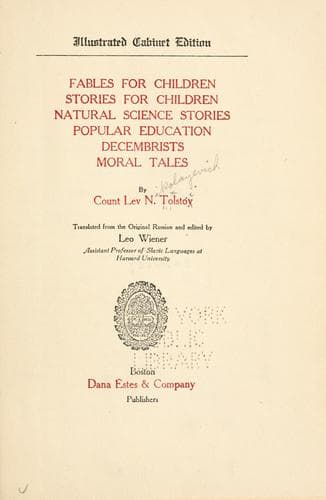
Fables for Children, Stories for Children, Natural Science Stories, Popular Education, Decembrists, Moral TalesTolstoy, Leo, graf
General
Fables for Children, Stories for Children, Natural Science Stories, Popular Education, Decembrists, Moral Tales
Tolstoy, Leo, graf
Russian literature -- Translations into English
They had enough grain until the next crop. From the oats they paid their
taxes and met all their obligations. An easy life, indeed, might Iván
have led with his children. But next door to him he had a neighbour,
Gavrílo the Lame, Gordyéy Ivánov's son. And there was an enmity between
him and Iván.
So long as old man Gordyéy was alive, and Iván's father ran the farm,
the peasants lived in neighbourly fashion. If the women needed a sieve
or a vat, or the men had to get another axle or wheel for a time, they
sent from one farm to another, and helped each other out in a
neighbourly way. If a calf ran into the yard of the threshing-floor,
they drove it out and only said: "Don't let it out, for the heap has not
yet been put away." And it was not their custom to put it away and lock
it up in the threshing-floor or in a shed, or to revile each other.
Thus they lived so long as the old men were alive. But when the young
people began to farm, things went quite differently.
The whole thing began from a mere nothing. A hen of Iván's
daughter-in-law started laying early. The young woman gathered the eggs
for Passion week. Every day she went to the shed to pick up an egg from
the wagon-box. But, it seems, the boys scared away the hen, and she flew
across the wicker fence to the neighbour's yard, and laid an egg there.
The young woman heard the hen cackle, so she thought:
"I have no time now, I must get the hut in order for the holiday; I will
go there later to get it."
In the evening she went to the wagon-box under the shed, to fetch the
egg, but it was not there. The young woman asked her mother-in-law and
her brother-in-law if they had taken it; but Taráska, her youngest
brother-in-law, said:
"Your hen laid an egg in the neighbour's yard, for she cackled there and
flew out from that yard."
The young woman went to look at her hen, and found her sitting with the
cock on the perch; she had closed her eyes and was getting ready to
sleep. The woman would have liked to ask her where she laid the egg, but
she would not have given her any answer. Then the young woman went to
her neighbour. The old woman met her.
"What do you want, young woman?"
"Granny, my hen has been in your yard to-day,--did she not lay an egg
there?"
"I have not set eyes on her. We have hens of our own, thank God, and
they have been laying for quite awhile. We have gathered our own eggs,
and we do not need other people's eggs. Young woman, we do not go to
other people's yards to gather eggs."
The young woman was offended. She said a word too much, the neighbour
answered with two, and the women began to scold. Iván's wife was
carrying water, and she, too, took a hand in it. Gavrílo's wife jumped
out, and began to rebuke her neighbour. She reminded her of things that
had happened, and mentioned things that had not happened at all. And the
tongue-lashing began. All yelled together, trying to say two words at
the same time. And they used bad words.
Public-domain text, read in full here on John Shaqi.
Reviews
Reviews
No reviews yet
Be the first to share your thoughts on this work.
Elsewhere in the archive
Join the Discussion
Join the discussion
Sign in to leave a comment or review.
Sign InorCreate an account