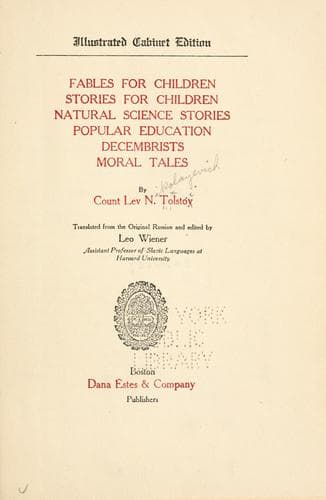
Fables for Children, Stories for Children, Natural Science Stories, Popular Education, Decembrists, Moral TalesTolstoy, Leo, graf
General
Fables for Children, Stories for Children, Natural Science Stories, Popular Education, Decembrists, Moral Tales
Tolstoy, Leo, graf
Russian literature -- Translations into English
"Do you think Christ has taught us anything bad? He has taught us for
our own good. Think of your earthly life: are you better off, or worse,
since that Plévna of yours was started? Figure out how much you have
spent on these courts, how much you have spent in travelling and in
feeding yourself on the way? See what eagles of sons you have! You ought
to live, and live well, and go up, but your property is growing less.
Why? For the same reason. From your pride. You ought to be ploughing
with the boys in the field and attend to your sowing, but the fiend
carries you to court or to some pettifogger. You do not plough in time
and do not sow in time, and mother earth does not bring forth anything.
Why did the oats not do well this year? When did you sow them? When you
came back from the city. And what did you gain from the court? Only
trouble for yourself. Oh, son, stick to your business, and attend to
your field and your house, and if any one has offended you, forgive him
in godly fashion, and things will go better with you, and you will feel
easier at heart."
Iván kept silence.
"Listen, Iván! Pay attention to me, an old man. Go and hitch the gray
horse, and drive straight back to the office: squash there the whole
business, and in the morning go to Gavrílo, make peace with him in godly
fashion, and invite him to the holiday" (it was before Lady-day), "have
the samovár prepared, get a half bottle, and make an end to all sins, so
that may never happen again, and command the women and children to live
in peace."
Iván heaved a sigh, and thought: "The old man is speaking the truth,"
and his heart melted. The only thing he did not know was how to manage
things so as to make peace with his neighbour.
And the old man, as though guessing what he had in mind, began once
more:
"Go, Iván, do not put it off! Put out the fire at the start, for when it
burns up, you can't control it."
The old man wanted to say something else, but did not finish, for the
women entered the room and began to prattle like magpies. The news had
already reached them about how Gavrílo had been sentenced to be flogged,
and how he had threatened to set fire to the house. They had found out
everything, and had had time in the pasture to exchange words with the
women of Gavrílo's house. They said that Gavrílo's daughter-in-law had
threatened them with the examining magistrate. The magistrate, they
said, was receiving gifts from Gavrílo. He would now upset the whole
case, and the teacher had already written another petition to the Tsar
about Iván, and that petition mentioned all the affairs, about the
coupling-pin, and about the garden,--and half of the estate would go
back to him. Iván listened to their talk, and his heart was chilled
again, and he changed his mind about making peace with Gavrílo.
Public-domain text, read in full here on John Shaqi.
Reviews
Reviews
No reviews yet
Be the first to share your thoughts on this work.
Elsewhere in the archive
Join the Discussion
Join the discussion
Sign in to leave a comment or review.
Sign InorCreate an account