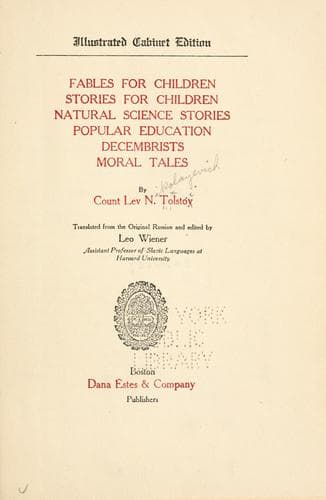
Fables for Children, Stories for Children, Natural Science Stories, Popular Education, Decembrists, Moral TalesTolstoy, Leo, graf
General
Fables for Children, Stories for Children, Natural Science Stories, Popular Education, Decembrists, Moral Tales
Tolstoy, Leo, graf
Russian literature -- Translations into English
And Iván and Gavrílo lived neighbourly together, just as their fathers
had lived. Iván Shcherbakóv remembered his father's injunction and God's
command to put out the fire in the beginning. And if a person did him
some harm, he did not try to have his revenge on the man, but to mend
matters; and if a person called him a bad name, he did not try to answer
with worse words still, but to teach him not to speak badly. And thus he
taught, also the women folk and the children. And Iván Shcherbakóv
improved and began to live better than ever.
THE CANDLE
1885
THE CANDLE
Ye have heard that it hath been said, An eye for an eye, and a
tooth for a tooth: but I say unto you, That ye resist not evil.
(Matt. v. 38, 39.)
This happened in the days of slavery. There were then all kinds of
masters. There were such as remembered their hour of death and God, and
took pity on their people, and there were dogs,--not by that may their
memory live! But there were no meaner masters than those who from
serfdom rose, as though out of the mud, to be lords! With them life was
hardest of all.
There happened to be such a clerk in a manorial estate. The peasants
were doing manorial labour. There was much land, and the land was good,
and there was water, and meadows, and forests. There would have been
enough for everybody, both for the master and for the peasants, but the
master had placed over them a clerk, a manorial servant of his from
another estate.
The clerk took the power into his own hand, and sat down on the
peasants' necks. He was a married man,--he had a wife and two married
daughters,--and had saved some money: he might have lived gloriously
without sin, but he was envious, and stuck fast in sin. He began by
driving the peasants to manorial labour more than the usual number of
days. He started a brick-kiln, and he drove all the men and women to
work in it above their strength, and sold the brick. The peasants went
to the proprietor in Moscow to complain against him, but they were not
successful. When the clerk learned that the peasants had entered a
complaint against him, he took his revenge out of them. The peasants led
a harder life still. There were found faithless people among the
peasants: they began to denounce their own brothers to the clerk, and to
slander one another. And all the people became involved, and the clerk
was furious.
The further it went, the worse it got, and the clerk carried on so
terribly that the people became afraid of him as of a wolf. When he
drove through the village, everybody ran away from him as from a wolf,
so as not to be seen by him. The clerk saw that and raved more than ever
because people were afraid of him. He tortured the peasants with beating
and with work, and they suffered very much from him.
It used to happen that such evil-doers were put out of the way, and the
peasants began to talk that way about him. They would meet somewhere
secretly, and such as were bolder would say:
Public-domain text, read in full here on John Shaqi.
Reviews
Reviews
No reviews yet
Be the first to share your thoughts on this work.
Elsewhere in the archive
Join the Discussion
Join the discussion
Sign in to leave a comment or review.
Sign InorCreate an account