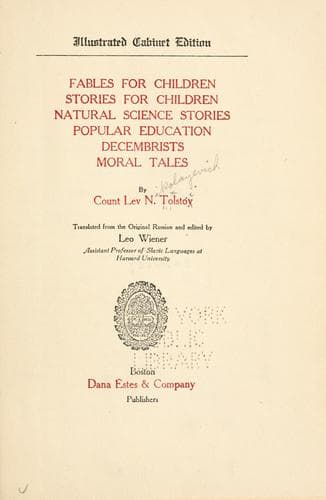
Fables for Children, Stories for Children, Natural Science Stories, Popular Education, Decembrists, Moral TalesTolstoy, Leo, graf
General
Fables for Children, Stories for Children, Natural Science Stories, Popular Education, Decembrists, Moral Tales
Tolstoy, Leo, graf
Russian literature -- Translations into English
"If he has forgotten God," they said, "and wants to do such things, we
must certainly kill him. We shall be ruined anyway."
Peter Mikhyéev came to them. He was a peaceable man, and did not take
counsel with the peasants. He came, and listened to their speeches, and
said:
"Brothers, you are planning a great crime. It is a serious matter to
ruin a soul. It is easy to ruin somebody else's soul, but how about our
own souls? He is doing wrong, and the wrong is at his door. We must
suffer, brothers."
Vasíli grew angry at these words.
"He has got it into his head that it is a sin to kill a man. Of course
it is, but what kind of a man is he? It is a sin to kill a good man, but
such a dog even God has commanded us to kill. A mad dog has to be
killed, if we are to pity men. If we do not kill him, there will be a
greater sin. What a lot of people he will ruin! Though we shall suffer,
it will at least be for other people. Men will thank us for it. If we
stand gaping he will ruin us all. You are speaking nonsense, Mikhyéev.
Will it be a lesser sin if we go to work on Christ's holiday? You
yourself will not go."
And Mikhyéev said:
"Why should I not go? If they send me, I will go to plough. It is not
for me. God will find out whose sin it is, so long as we do not forget
him. Brothers, I am not speaking for myself. If we were enjoined to
repay evil with evil, there would be a commandment of that kind, but we
are taught just the opposite. You start to do away with evil, and it
will only pass into you. It is not a hard thing to kill a man. But the
blood sticks to your soul. To kill a man means to soil your soul with
blood. You imagine that when you kill a bad man you have got rid of the
evil, but, behold, you have reared a worse evil within you. Submit to
misfortune, and misfortune will be vanquished."
The peasants could not come to any agreement: their thoughts were
scattered. Some of them believed with Vasíli, and others agreed with
Peter's speech that they ought not commit a crime, but endure.
The peasants celebrated the first day, the Sunday. In the evening the
elder came with the deputies from the manor, and said:
"Mikhaíl Seménovich, the clerk, has commanded me to get all the peasants
ready for the morrow, to plough the field for the oats." The elder made
the round of the village with the deputies and ordered all to go out on
the morrow to plough, some beyond the river, and some from the highway.
The peasants wept, but did not dare to disobey, and on the morrow went
out with their ploughs and began to plough.
Mikhaíl Seménovich, the clerk, awoke late, and went out to look after
the farm. His home folk--his wife and his widowed daughter (she had come
for the holidays)--were all dressed up. A labourer hitched a cart for
them, and they went to mass, and returned home again. A servant made the
samovár, and when Mikhaíl Seménovich came, they sat down to drink tea.
Mikhaíl Seménovich drank his tea, lighted a pipe, and sent for the
elder.
Public-domain text, read in full here on John Shaqi.
Reviews
Reviews
No reviews yet
Be the first to share your thoughts on this work.
Elsewhere in the archive
Join the Discussion
Join the discussion
Sign in to leave a comment or review.
Sign InorCreate an account