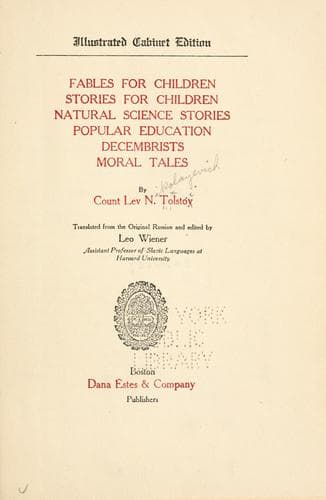
Fables for Children, Stories for Children, Natural Science Stories, Popular Education, Decembrists, Moral TalesTolstoy, Leo, graf
General
Fables for Children, Stories for Children, Natural Science Stories, Popular Education, Decembrists, Moral Tales
Tolstoy, Leo, graf
Russian literature -- Translations into English
Efím Tarásych left all his affairs in the hands of his eldest son: he
told him where to mow, and how many fields to mow, and where to haul the
manure, and how to finish the hut and thatch it. He considered
everything, and gave his orders. But all the order that Eliséy gave was
that his wife should set out the young brood separately from the hives
sold and give the neighbour what belonged to him without cheating him,
but about domestic affairs he did not even speak: "The needs
themselves," he thought, "will show you what to do and how to do it. You
have been farming yourselves, so you will do as seems best to you."
The old men got ready. The home folk baked a lot of flat cakes for them,
and they made wallets for themselves, cut out new leg-rags, put on new
short boots, took reserve bast shoes, and started. The home folk saw
them off beyond the enclosure and bade them good-bye, and the old men
were off for their pilgrimage.
Eliséy left in a happy mood, and as soon as he left his village he
forgot all his affairs. All the care he had was how to please his
companion, how to keep from saying an unseemly word to anybody, how to
reach the goal in peace and love, and how to get home again. As Eliséy
walked along the road he either muttered some prayer or repeated such of
the lives of the saints as he knew. Whenever he met a person on the
road, or when he came to a hostelry, he tried to be as kind to everybody
as he could, and to say to them God-fearing words. He walked along and
was happy. There was only one thing Eliséy could not do: he wanted to
stop taking snuff and had left his snuff-box at home, but he hankered
for it. On the road a man offered him some. He wrangled with himself and
stepped away from his companion so as not to lead him into sin, and took
a pinch.
Efím Tarásych walked firmly and well; he did no wrong and spoke no vain
words, but there was no lightness in his heart. The cares about his home
did not leave his mind. He was thinking all the time about what was
going on at home,--whether he had not forgotten to give his son some
order, and whether his son was doing things in the right way. When he
saw along the road that they were setting out potatoes or hauling
manure, he wondered whether his son was doing as he had been ordered. He
just felt like returning, and showing him what to do, and doing it
himself.
III.
Public-domain text, read in full here on John Shaqi.
Reviews
Reviews
No reviews yet
Be the first to share your thoughts on this work.
Elsewhere in the archive
Join the Discussion
Join the discussion
Sign in to leave a comment or review.
Sign InorCreate an account