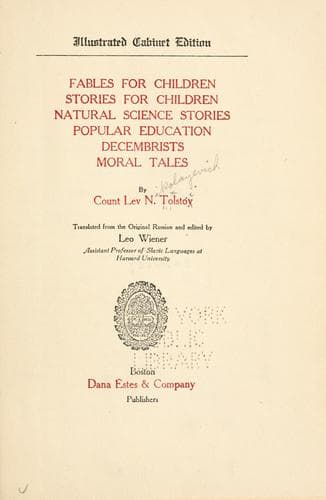
Fables for Children, Stories for Children, Natural Science Stories, Popular Education, Decembrists, Moral TalesTolstoy, Leo, graf
General
Fables for Children, Stories for Children, Natural Science Stories, Popular Education, Decembrists, Moral Tales
Tolstoy, Leo, graf
Russian literature -- Translations into English
Eliséy came up to the hut. It was a small clay cabin; the lower part was
black, the upper white, and the clay had long ago crumbled
off,--evidently it had not been plastered for a long time,--and the roof
was open at one end. The entrance was from the yard. Eliséy stepped into
the yard, and there saw that a lean, beardless man with his shirt stuck
in his trousers in Little-Russian fashion was lying near the earth
mound. The man had evidently lain down in a cool spot, but now the sun
was burning down upon him. He was lying there awake. Eliséy called out
to him, asking him to give him a drink, but the man made no reply. "He
is either sick, or an unkind man," thought Eliséy, going up to the door.
Inside he heard a child crying. He knocked with the door-ring. "Good
people!" No answer. He struck with his staff against the door.
"Christian people!" No stir. "Servants of the Lord!" No reply. Eliséy
was on the point of going away, when he heard somebody groaning within.
"I wonder whether some misfortune has happened there to the people. I
must see." And Eliséy went into the hut.
IV.
Eliséy turned the ring,--the door was not locked. He pushed the door
open and walked through the vestibule. The door into the living-room was
open. On the left there was an oven; straight ahead was the front
corner; in the corner stood a shrine and a table; beyond the table was a
bench, and on it sat a bareheaded old woman, in nothing but a shirt; her
head was leaning on the table, and near her stood a lean little boy, his
face as yellow as wax and his belly swollen, and he was pulling the old
woman's sleeve, and crying at the top of his voice and begging for
something.
Eliséy entered the room. There was a stifling air in the house. He saw a
woman lying behind the oven, on the floor. She was lying on her face
without looking at anything, and snoring, and now stretching out a leg
and again drawing it up. And she tossed from side to side,--and from her
came that oppressive smell: evidently she was very sick, and there was
nobody to take her away. The old woman raised her head, when she saw the
man.
"What do you want?" she said, in Little-Russian. "What do you want? We
have nothing, my dear man."
Eliséy understood what she was saying: he walked over to her.
"Servant of the Lord," he said, "I have come in to get a drink of
water."
"There is none, I say, there is none. There is nothing here for you to
take. Go!"
Eliséy asked her:
"Is there no well man here to take this woman away?"
"There is nobody here: the man is dying in the yard, and we here."
The boy grew quiet when he saw the stranger, but when the old woman
began to speak, he again took hold of her sleeve.
"Bread, granny, bread!" and he burst out weeping.
Public-domain text, read in full here on John Shaqi.
Reviews
Reviews
No reviews yet
Be the first to share your thoughts on this work.
Elsewhere in the archive
Join the Discussion
Join the discussion
Sign in to leave a comment or review.
Sign InorCreate an account