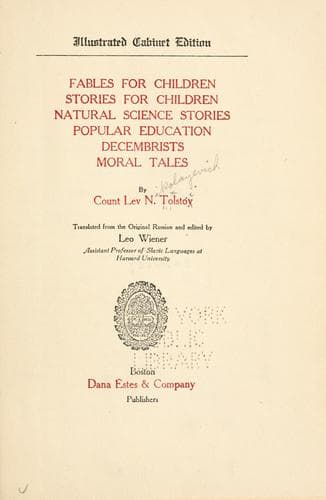
Fables for Children, Stories for Children, Natural Science Stories, Popular Education, Decembrists, Moral TalesTolstoy, Leo, graf
General
Fables for Children, Stories for Children, Natural Science Stories, Popular Education, Decembrists, Moral Tales
Tolstoy, Leo, graf
Russian literature -- Translations into English
They came to the church. There was there collected a large crowd of
worshippers, Greeks, and Armenians, and Turks, and Syrians. Efím came
with the people to the Holy Gate. A monk led them. He took them past the
Turkish guard to the place where the Saviour was taken from the cross
and anointed, and where candles were burning in nine large candlesticks.
He showed and explained everything to them. Efím placed a candle there.
Then the monks led Efím to the right over steps to Golgotha, where the
cross stood; there Efím prayed; then Efím was shown the cleft where the
earth was rent to the lowermost regions; then he was shown the place
where Christ's hands and feet had been nailed to the cross, and then he
was shown Adam's grave, where Christ's blood dropped on his bones. Then
they came to the rock on which Christ sat when they put the wreath of
thorns on his head; then to the post to which Christ was tied when he
was beaten. Then Efím saw the stone with the two holes, for Christ's
feet. They wanted to show him other things, but the people hastened
away: all hurried to the grotto of the Lord's Sepulchre. Some foreign
mass was just ended, and the Russian began. Efím followed the people to
the grotto.
He wanted to get away from the pilgrim, for in thought he still sinned
against him, but the pilgrim stuck to him, and went with him to mass at
the Sepulchre of the Lord. They wanted to stand close to it, but were
too late. There was such a crowd there that it was not possible to move
forward or back. Efím stood there and looked straight ahead and prayed,
but every once in awhile he felt his purse, to see whether it was in his
pocket. His thoughts were divided; now he thought that the pilgrim had
deceived him; and then he thought, if he had not deceived him, and the
pocketbook had really been stolen, the same might happen to him.
X.
Efím stood there and prayed and looked ahead into the chapel where the
Sepulchre itself was, and where over the Sepulchre thirty-six lamps were
burning. Efím looked over the heads to see the marvellous thing: under
the very lamps, where the blessed fire was burning, in front of all, he
saw an old man in a coarse caftan, with a bald spot shining on his whole
head, and he looked very much like Eliséy Bodróv.
"He resembles Eliséy," he thought. "But how can it be he? He could not
have got here before me. The previous ship started a week ahead of us.
He could not have been on that ship. On our ship he was not, for I saw
all the pilgrims."
Just as Efím was thinking this, the old man began to pray, and made
three bows: once in front of him, to God, and twice to either side, to
all the Orthodox people. And as the old man turned his head to the
right, Efím recognized him. Sure enough, it was Bodróv: it was his
blackish, curly beard, and the gray streak on his cheeks, and his brows,
his eyes, his nose, and full face,--all his. Certainly it was he, Eliséy
Bodróv.
Public-domain text, read in full here on John Shaqi.
Reviews
Reviews
No reviews yet
Be the first to share your thoughts on this work.
Elsewhere in the archive
Join the Discussion
Join the discussion
Sign in to leave a comment or review.
Sign InorCreate an account