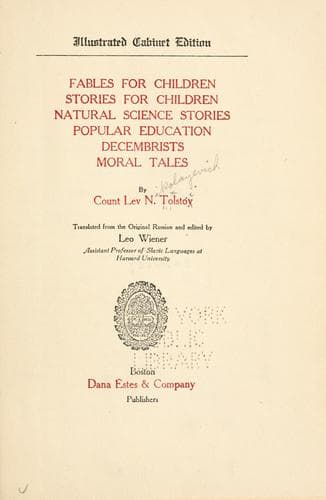
Fables for Children, Stories for Children, Natural Science Stories, Popular Education, Decembrists, Moral TalesTolstoy, Leo, graf
General
Fables for Children, Stories for Children, Natural Science Stories, Popular Education, Decembrists, Moral Tales
Tolstoy, Leo, graf
Russian literature -- Translations into English
And they began to dispute and to recall his words and deeds: where he
had sat down, and where he had slept, and what he had done, and what he
had said to each.
Toward evening the master of the house came home on a horse, and he,
too, began to tell about Eliséy, and how he had stayed at their house.
"If he had not come to us," he said, "we should all of us have died in
sin. We were dying in despair, and we murmured against God and men. But
he put us on our feet, and through him we found out God, and began to
believe in good people. May Christ save him! Before that we lived like
beasts, and he has made men of us."
They gave Efím to eat and to drink, and gave him a place to sleep, and
themselves went to bed.
As Efím lay down, he could not sleep, and Eliséy did not leave his mind,
but he thought of how he had seen him three times in Jerusalem in the
foremost place.
"So this is the way he got ahead of me," he thought. "My work may be
accepted or not, but his the Lord has accepted."
In the morning Efím bade the people good-bye: they filled his wallet
with cakes and went to work, while Efím started out on the road.
XII.
Efím was away precisely a year. In the spring he returned home.
He reached his house in the evening. His son was not at home,--he was in
the dram-shop. He returned intoxicated, and Efím began to ask him about
the house. He saw by everything that the lad had got into bad ways
without him. He had spent all the money, and the business he had
neglected. His father scolded him, and he answered his father with rude
words.
"You ought to have come back yourself," he said. "Instead, you went away
and took all the money with you, and now you make me responsible."
The old man became angry and beat his son.
The next morning Efím Tarásych went to the elder to talk to him about
his son. As he passed Eliséy's farm, Eliséy's wife was standing on the
porch and greeting him:
"Welcome, friend!" she said. "Did you, dear man, have a successful
journey?"
Efím Tarásych stopped.
"Thank God," he said, "I have been at Jerusalem, but I lost your husband
on the way. I hear that he is back."
And the old woman started to talk to him, for she was fond of babbling.
"He is back, my dear; he has been back for quite awhile. He returned
soon after Assumption day. We were so glad to see him back. It was
lonely without him. Not that we mean his work,--for he is getting old.
But he is the head, and it is jollier for us. How happy our lad was!
Without him, he said, it was as without light for the eyes. It was
lonely without him, my dear. We love him so much!"
"Well, is he at home now?"
"At home he is, neighbour, in the apiary, brushing in the swarms. He
says it was a fine swarming season. The old man does not remember when
there has been such a lot of bees. God gives us not according to our
sins, he says. Come in, dear one! He will be so glad to see you."
Public-domain text, read in full here on John Shaqi.
Reviews
Reviews
No reviews yet
Be the first to share your thoughts on this work.
Elsewhere in the archive
Join the Discussion
Join the discussion
Sign in to leave a comment or review.
Sign InorCreate an account