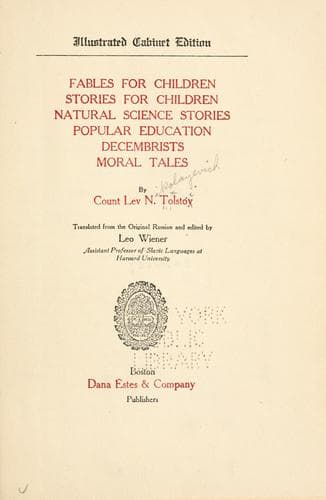
Fables for Children, Stories for Children, Natural Science Stories, Popular Education, Decembrists, Moral TalesTolstoy, Leo, graf
General
Fables for Children, Stories for Children, Natural Science Stories, Popular Education, Decembrists, Moral Tales
Tolstoy, Leo, graf
Russian literature -- Translations into English
"He is a big man! He used to be the first dzhigit: he killed a lot of
Russians, and he was rich. He had three wives and eight sons. All of
them lived in the same village. The Russians came, destroyed the
village, and killed seven of his sons. One son was left alive, and he
surrendered himself to the Russians. The old man went and surrendered
himself, too, to the Russians. He stayed with them three months, found
his son there, and killed him, and then he ran away. Since then he has
stopped fighting. He has been to Mecca, to pray to God, and that is why
he wears the turban. He who has been to Mecca is called a Hadji and puts
on a turban. He has no use for you fellows. He tells me to kill you;
but I cannot kill you,--I have paid for you; and then, Iván, I like you.
I not only have no intention of killing you, but I would not let you go
back, if I had not given my word to you." He laughed as he said that,
and added in Russian: "You, Iván, good, me, Abdul, good!"
IV.
Zhilín lived thus for a month. In the daytime he walked around the
village and made things with his hands, and when night came, and all was
quiet in the village, he began to dig in the shed. It was difficult to
dig on account of the rocks, but he sawed the stones with the file, and
made a hole through which he meant to crawl later. "First I must find
out what direction to go in," he thought; "but the Tartars will not tell
me anything."
So he chose a time when his master was away; he went after dinner back
of the village, up-hill, where he could see the place. But when his
master went away, he told his little boy to keep an eye on Zhilín and to
follow him everywhere. So the boy ran after Zhilín, and said:
"Don't go! Father said that you should not go there. I will call the
people!"
Zhilín began to persuade him.
"I do not want to go far," he said; "I just want to walk up the
mountain: I want to find an herb with which to cure you people. Come
with me; I cannot run away with the stocks. To-morrow I will make you a
bow and arrows."
He persuaded the boy, and they went together. As he looked up the
mountain, it looked near, but with the stocks it was hard to walk; he
walked and walked, and climbed the mountain with difficulty. Zhilín sat
down and began to look at the place. To the south of the shed there was
a ravine, and there a herd of horses was grazing, and in a hollow could
be seen another village. At that village began a steeper mountain, and
beyond that mountain there was another mountain. Between the mountains
could be seen a forest, and beyond it again the mountains, rising higher
and higher. Highest of all, there were white mountains, capped with
snow, just like sugar loaves. And one snow mountain stood with its cap
above all the rest. To the east and the west there were just such
mountains; here and there smoke rose from villages in the clefts.
"Well," he thought, "that is all their side."
Public-domain text, read in full here on John Shaqi.
Reviews
Reviews
No reviews yet
Be the first to share your thoughts on this work.
Join the Discussion
Join the discussion
Sign in to leave a comment or review.
Sign InorCreate an account