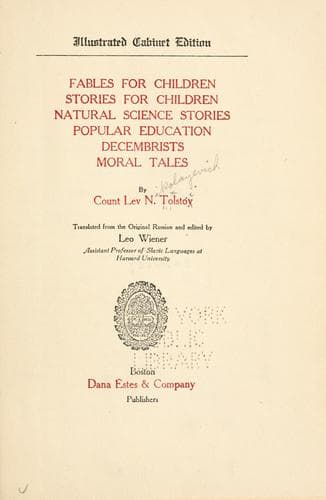
Fables for Children, Stories for Children, Natural Science Stories, Popular Education, Decembrists, Moral TalesTolstoy, Leo, graf
General
Fables for Children, Stories for Children, Natural Science Stories, Popular Education, Decembrists, Moral Tales
Tolstoy, Leo, graf
Russian literature -- Translations into English
After that the rumour went abroad that Zhilín was a great master. They
began to come to him from distant villages: one, to have him fix a
gun-lock or a pistol, another, to set a clock a-going. His master
brought him tools,--pinchers, gimlets, and files.
One day a Tartar became sick: they sent to Zhilín, and said, "Go and
cure him!" Zhilín did not know anything about medicine. He went, took a
look at him, and thought, "Maybe he will get well by himself." He went
to the barn, took some water and sand, and mixed it. In the presence of
the Tartars he said a charm over the water, and gave it to him to drink.
Luckily for him, the Tartar got well.
Zhilín began to understand their language. Some of the Tartars got used
to him. When they needed him, they called, "Iván, Iván!" but others
looked at him awry, as at an animal.
The red Tartar did not like Zhilín. Whenever he saw him, he frowned and
turned away, or called him names. There was also an old man; he did not
live in the village, but came from farther down the mountain. Zhilín saw
him only when he came to the mosque, to pray to God. He was a small man;
his cap was wrapped with a white towel. His beard and moustache were
clipped, and they were as white as down; his face was wrinkled and as
red as a brick. His nose was hooked, like a hawk's beak, and his eyes
were gray and mean-looking; of teeth he had only two tusks. He used to
walk in his turban, leaning on a crutch, and looking around him like a
wolf. Whenever he saw Zhilín, he grunted and turned away.
One day Zhilín went down-hill, to see where the old man was living. He
walked down the road, and saw a little garden, with a stone fence, and
inside the fence were cherry and apricot trees, and stood a hut with a
flat roof. He came closer to it, and he saw beehives woven from straw,
and bees were swarming around and buzzing. The old man was kneeling, and
doing something to a hive. Zhilín got up higher, to get a good look, and
made a noise with his stocks. The old man looked around and shrieked; he
pulled the pistol out from his belt and fired at Zhilín. He had just
time to hide behind a rock.
The old man went to the master to complain about Zhilín. The master
called up Zhilín, and laughed, and asked:
"Why did you go to the old man?"
"I have not done him any harm," he said. "I just wanted to see how he
lives."
The master told the old man that. But the old man was angry, and hissed,
and rattled something off; he showed his teeth and waved his hand
threateningly at Zhilín.
Zhilín did not understand it all; but he understood that the old man was
telling his master to kill all the Russians, and not to keep them in the
village. The old man went away.
Zhilín asked his master what kind of a man that old Tartar was. The
master said:
Public-domain text, read in full here on John Shaqi.
Reviews
Reviews
No reviews yet
Be the first to share your thoughts on this work.
Join the Discussion
Join the discussion
Sign in to leave a comment or review.
Sign InorCreate an account