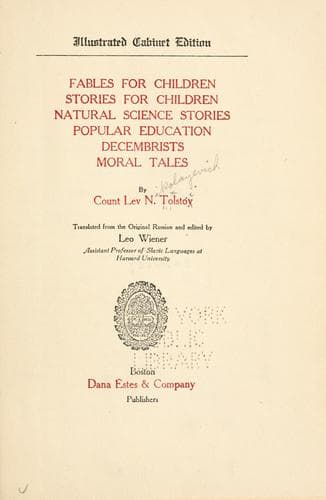
Fables for Children, Stories for Children, Natural Science Stories, Popular Education, Decembrists, Moral TalesTolstoy, Leo, graf
General
Fables for Children, Stories for Children, Natural Science Stories, Popular Education, Decembrists, Moral Tales
Tolstoy, Leo, graf
Russian literature -- Translations into English
For this purpose pieces of different metals are placed in jars, and
liquids are poured into them. Electricity is collected in these jars,
and is transferred by means of wires to the place where it is wanted,
and from that place the wire is put into the ground. The electricity
runs through the ground back to the jars, and rises from the earth by
means of the other wire; thus the electricity keeps going around and
around, as in a ring,--from the wire into the ground, and along the
ground, and up the wire, and again through the earth. Electricity can
travel in either direction, just as one wants to send it: it can first
go along the wire and return through the earth, or first go through the
earth, and then return through the wire. Above the wire, in the place
where the signs are given, there is attached a magnetic hand, and that
hand turns in one direction, when the electricity is allowed to pass
through the wire and back through the earth, and in another direction,
when the electricity is sent through the earth and back through the
wire. Along this hand there are certain signs, and by means of these
signs they write from one place to another on the telegraph.
THE SUN'S HEAT
Go out in the winter on a calm, frosty day into the field, or into the
woods, and look about you and listen: all around you is snow, the rivers
are frozen, dry grass blades stick out of the grass, the trees are
bare,--nothing is moving.
Look in the summer: the rivers are running and rippling, in every puddle
the frogs croak and plunge in; the birds fly from place to place, and
whistle, and sing; the flies and the gnats whirl around and buzz; the
trees and the grass grow and wave to and fro.
Freeze a pot with water, and it will become as hard as a rock. Put the
frozen pot on the fire: the ice will begin to break, and melt, and move;
the water will begin to stir, and bubbles will rise; then, when it
begins to boil, it whirls about and makes a noise. The same happens in
the world from the heat. Without heat everything is dead; with the heat
everything moves and lives. If there is little heat, there is little
motion; with more heat, there is more motion; with much heat, there is
much motion; with very much heat, there is also very much motion.
Where does the heat in the world come from? The heat comes from the sun.
In winter the sun travels low, to one side, and its beams do not fall
straight upon the earth, and nothing moves. The sun begins to travel
higher above our heads, and begins to shine straight down upon the
earth, and everything is warmed up in the world, and begins to stir.
The snow settles down; the ice begins to melt on the rivers; the water
comes down from the mountains; the vapours rise from the water to the
clouds, and rain begins to fall. Who does it all?--The sun. The seeds
swell, and let out rootlets; the rootlets take hold of the ground; old
roots send up new shoots, and the trees and the grass begin to grow. Who
has done that?--The sun.
Public-domain text, read in full here on John Shaqi.
Reviews
Reviews
No reviews yet
Be the first to share your thoughts on this work.
Elsewhere in the archive
Join the Discussion
Join the discussion
Sign in to leave a comment or review.
Sign InorCreate an account