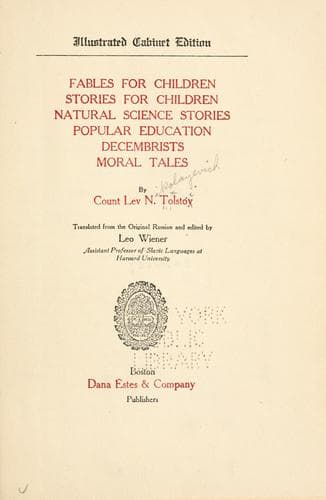
Fables for Children, Stories for Children, Natural Science Stories, Popular Education, Decembrists, Moral TalesTolstoy, Leo, graf
General
Fables for Children, Stories for Children, Natural Science Stories, Popular Education, Decembrists, Moral Tales
Tolstoy, Leo, graf
Russian literature -- Translations into English
"I will stick one claw into his body, and with the other I will clutch a
tree."
The young owl made for the hare, and stuck one claw into his back so
that all his talons entered the flesh, and the other claw it got ready
to push into the tree. The hare yanked the owl, while the owl held on to
the tree, and thought, "He will not get away." The hare darted forward
and tore the owl. One claw was left in the tree, and the other in the
hare's back.
The next year a hunter killed that hare, and wondered how the owl's
talons had grown into the hare's back.
HOW THE WOLVES TEACH THEIR WHELPS
I was walking along the road, and heard a shout behind me. It was the
shepherd boy who was shouting. He was running through the field, and
pointing to something.
I looked, and saw two wolves running through the field: one was
full-grown, and the other a whelp. The whelp was carrying a dead lamb on
his shoulders, and holding on to one of its legs with its teeth. The old
wolf was running behind. When I saw the wolves, I ran after them with
the shepherd, and we began to shout. In response to our cries came
peasants with dogs.
The moment the old wolf saw the dogs and the people, he ran up to the
whelp, took the lamb away from him, threw it over his back, and both
wolves ran as fast as they could, and disappeared from view.
Then the boy told what had happened: the large wolf had leaped out from
the ravine, had seized the lamb, killed it, and carried it off.
The whelp ran up to him and grasped the lamb. The old wolf let the whelp
carry the lamb, while he himself ran slowly beside him.
Only when there was danger, did the old wolf stop his teaching and
himself take the lamb.
HARES AND WOLVES
The hares feed at night on tree bark; the field hares eat the winter rye
and the grass, and the threshing-floor hares eat the grain in the
granary. Through the night the hares make a deep, visible track through
the snow. The hares are hunted by men, and dogs, and wolves, and foxes,
and ravens, and eagles. If a hare walked straight ahead, he would be
easily caught in the morning by his tracks; but God has made a hare
timid, and his timidity saves him.
A hare goes at night fearlessly through the forests and fields, making
straight tracks; but as soon as morning comes and his enemies wake up,
and he hears the bark of dogs, or the squeak of sleighs, or the voice of
peasants, or the crashing of a wolf through the forest, he begins to
toss from side to side in his fear. He jumps forward, gets frightened at
something, and runs back on his track. He hears something again, and he
leaps at full speed to one side and runs away from his old track. Again
something makes a noise, and the hare turns back, and again leaps to one
side. When it is daylight, he lies down.
Public-domain text, read in full here on John Shaqi.
Reviews
Reviews
No reviews yet
Be the first to share your thoughts on this work.
Elsewhere in the archive
Join the Discussion
Join the discussion
Sign in to leave a comment or review.
Sign InorCreate an account