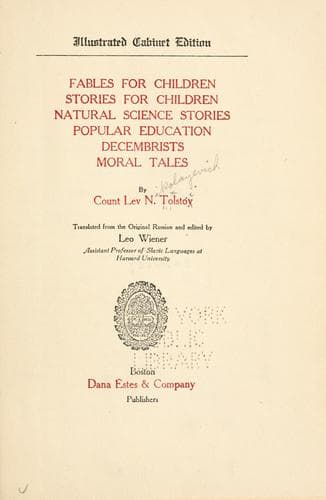
Fables for Children, Stories for Children, Natural Science Stories, Popular Education, Decembrists, Moral TalesTolstoy, Leo, graf
General
Fables for Children, Stories for Children, Natural Science Stories, Popular Education, Decembrists, Moral Tales
Tolstoy, Leo, graf
Russian literature -- Translations into English
A workman crawled under it, and called out:
"It has another root; it is out on the path!"
I walked over to him, and saw that it was so.
Not to be choked by the linden, the bird-cherry had gone away from
underneath the linden out on the path, about eight feet from its former
root. The root which I had cut down was rotten and dry, but the new one
was fresh. The bird-cherry had evidently felt that it could not exist
under the linden, so it had stretched out, dropped a branch to the
ground, made a root of that branch, and left the other root. Only then
did I understand how the first bird-cherry had grown out on the road. It
had evidently done the same,--only it had had time to give up the old
root, and so I had not found it.
THE DECEMBRISTS
Fragments of a Novel
1863-1878
THE DECEMBRISTS
A Novel
FIRST FRAGMENT
I.
This happened not long ago, in the reign of Alexander II., in our days
of civilization, progress, questions, regeneration of Russia, and so
forth, and so forth; at a time when the victorious Russian army was
returning from Sevastopol, surrendered to the enemy; when all of Russia
celebrated the annihilation of the Black Sea fleet, and white-stoned
Moscow received and congratulated with this happy event the remainders
of the crews of that fleet, offering them a good Russian cup of vódka,
and bread and salt, according to the good Russian custom, and bowing
down to their feet. It was that time when Russia, in the person of
far-sighted virgin politicians, lamented the shattered dream of a Te
Deum in the Cathedral of St. Sophia, and the loss of two great men, so
painful for the country, who had perished during the war (one, who had
been carried away by the desire to celebrate the Te Deum in the
above-mentioned cathedral at the earliest time possible, and who fell in
the fields of Wallachia, but who, at least, left two squadrons of
hussars in the same fields, and the other, an unappreciated man, who had
distributed tea, other people's money, and bed-sheets to the wounded,
without stealing any of these things); that time, when on all sides, in
all branches of human activities, great men--generals, administrators,
economists, writers, orators, and simply great men, without any especial
calling or purpose--sprang up in Russia like mushrooms; that time, when,
at the jubilee of a Moscow actor, there appeared the public opinion,
confirmed by a toast, which began to rebuke all the criminals,--when
menacing commissions galloped south from St. Petersburg, to convict and
punish the evil-doers of the commissariat,--when in all the cities
dinners with speeches were given to the heroes of Sevastopol, and when
to them, with arms and legs torn off, toasts were drunk, on meeting them
on the bridges and on the highways; that time, when oratorical talents
developed so rapidly in the nation that a certain dram-shopkeeper
everywhere and upon all occasions wrote and printed and recited by rote
Public-domain text, read in full here on John Shaqi.
Reviews
Reviews
No reviews yet
Be the first to share your thoughts on this work.
Elsewhere in the archive
Join the Discussion
Join the discussion
Sign in to leave a comment or review.
Sign InorCreate an account