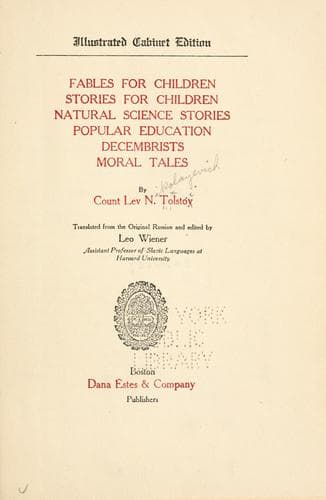
Fables for Children, Stories for Children, Natural Science Stories, Popular Education, Decembrists, Moral TalesTolstoy, Leo, graf
General
Fables for Children, Stories for Children, Natural Science Stories, Popular Education, Decembrists, Moral Tales
Tolstoy, Leo, graf
Russian literature -- Translations into English
That is a state of affairs which has been twice repeated in the Russia
of the nineteenth century,--the first time, when in the year '12 we
repulsed Napoleon I., and the second time, when in the year '56 we were
repulsed by Napoleon III. Great, unforgettable time of the regeneration
of the Russian people! Like the Frenchman who said that he has not lived
who has not lived through the great French Revolution, I venture to say
that he who has not lived through the year '56 in Russia does not know
what life is. The writer of these lines not only lived through that
time, but was one of the actors of that period. Not only did he pass
several weeks in one of the blindages of Sevastopol, but he also wrote a
work on the Crimean War, which brought him great fame, and in which he
described clearly and minutely how the soldiers fired their guns from
the bastions, how the wounds were dressed at the ambulance, and how they
buried people in the cemetery. Having achieved these deeds, the writer
of these lines arrived in the centre of the empire,--a rocket
establishment,--where he cut the laurels for his deeds. He saw the
transports of the two capitals and of the whole nation, and experienced
in his person to what extent Russia knew how to reward real deserts. The
mighty of this world sought his friendship, pressed his hands, gave him
dinners, urged him to come to their houses, and, in order to learn the
details of the war from him, informed him of their own sentimentalities.
Consequently the writer of these lines can appreciate that great and
memorable time. But that is another matter.
At that very time, two vehicles on wheels and a sleigh were standing at
the entrance of the best Moscow hotel. A young man ran through the door,
to find out about quarters. In one of the vehicles sat an old man with
two ladies. He was talking about the condition of Blacksmith Bridge in
the days of the French. It was the continuation of a conversation
started as they entered Moscow, and now the old man with the white
beard, in his unbuttoned fur coat, calmly continued his conversation in
the vehicle, as though he intended to stay in it overnight. His wife and
daughter listened to him, but kept looking at the door with some
impatience. The young man emerged from the door with the porter and room
servant.
"Well, Sergyéy," asked the mother, thrusting her emaciated face out into
the glare of the lamplight.
Either because it was his habit, or because he did not wish the porter
to take him for a lackey on account of the short fur coat which he wore,
Sergyéy replied in French that there were rooms to be had, and opened
the carriage door. The old man looked for a moment at his son, and again
turned to the dark corner of the vehicle, as though nothing else
concerned him:
"There was no theatre then."
"Pierre!" said his wife, lifting her cloak; but he continued:
"Madame Chalmé was in Tverskáya Street--"
Deep in the vehicle could be heard a youthful, sonorous laugh.
Public-domain text, read in full here on John Shaqi.
Reviews
Reviews
No reviews yet
Be the first to share your thoughts on this work.
Elsewhere in the archive
Join the Discussion
Join the discussion
Sign in to leave a comment or review.
Sign InorCreate an account