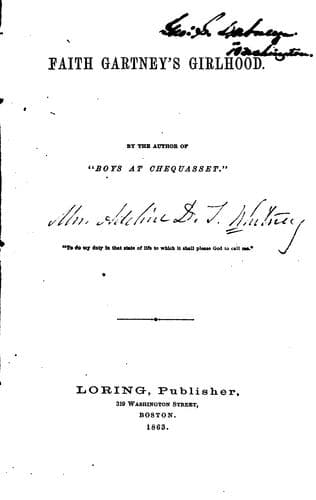
Faith Gartney's GirlhoodWhitney, A. D. T. (Adeline Dutton Train)
General
Faith Gartney's Girlhood
Whitney, A. D. T. (Adeline Dutton Train)
Teenage girls -- Juvenile fiction
"You shall do as you like," answered Mr. Rushleigh. "But it belongs to
us to care for you, I think."
"You do--you have cared for me already," said Faith, earnestly.
And Mr. Rushleigh helped to wrap her up, and kissed her forehead
tenderly, and Roger Armstrong lifted her into the chaise, and seated
himself by her, and drove her away from out the smoke and noise and
curious crowd that had begun to find out she was there, and that she had
been shut up in the mill, and had saved herself and stopped the fire;
and would have made her as uncomfortable as crowds always do heroes or
heroines--had it not been for the friend beside her, whose foresight and
precaution had warded it all off.
And the mill owner went back among the villagers and firemen, to direct
their efforts for his property.
Glory McWhirk had been up and watching the great fire, since Roger
Armstrong first went out.
She had seen it from the window of Miss Henderson's room, where she was
to sleep to-night; and had first carefully lowered the blinds lest the
light should waken her mistress, who, after suffering much pain, had at
length, by the help of an anodyne, fallen asleep; and then she had come
round softly to the southwest room, to call the minister.
The door stood open, and she saw him sitting in his chair, asleep. Just
as she crossed the threshold to come toward him, he started, and spoke
those words out of his restless dream:
"Faith! Faith! What danger is about you, child?"
They were instinct with his love. They were eager with his visionary
fear. It only needed a human heart to interpret them.
Glory drew back as he sprang to his feet, and noiselessly disappeared.
She would not have him know that she had heard this cry with which he
waked.
"He dreamed about her! and he called her Faith. How beautiful it is to
be cared for so!"
Glory--while we have so long been following Faith--had no less been
living on her own, peculiar, inward life, that reached to, that
apprehended, that seized ideally--that was denied, so much!
As Glory had seen, in the old years, children happier than herself,
wearing beautiful garments, and "hair that was let to grow," she saw
those about her now whom life infolded with a grace and loveliness she
might not look for; about whom fair affections, "let to grow," clustered
radiant, and enshrined them in their light.
She saw always something that was beyond; something she might not
attain; yet, expectant of nothing, but blindly true to the highest
within her, she lost no glimpse of the greater, through lowering herself
to the less.
Her soul of womanhood asserted itself; longing, ignorantly, for a soul
love. "To be cared for, so!"
But she would rather recognize it afar--rather have her joy in knowing
the joy that might be--than shut herself from knowledge in the content
of a common, sordid lot.
She did not think this deliberately, however; it was not reason, but
instinct. She renounced unconsciously. She bore denial, and never knew
she was denied.
Public-domain text, read in full here on John Shaqi.
Reviews
Reviews
No reviews yet
Be the first to share your thoughts on this work.
Elsewhere in the archive
Join the Discussion
Join the discussion
Sign in to leave a comment or review.
Sign InorCreate an account