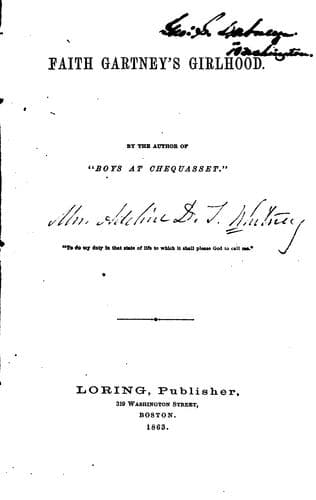
Faith Gartney's GirlhoodWhitney, A. D. T. (Adeline Dutton Train)
General
Faith Gartney's Girlhood
Whitney, A. D. T. (Adeline Dutton Train)
Teenage girls -- Juvenile fiction
She had a word that night from Robert Armstrong, when he came, late in
the evening, from a conversation with Aunt Faith, and found her at the
open door upon the stoop. It was only a hand grasp, and a fervent "God
bless you, child! You have been brave and true!" and he passed on. But a
balm and a quiet fell deep into her heart, and a tone, that was a joy,
lingered in her ear, and comforted her as no other earthly comfort
could. But this was not all earthly; it lifted her toward heaven. It
bore her toward the eternal solace there.
Aunt Faith would have no scenes. She told the others, in turn, very much
as she had told Faith, that a suffering and an uncertainty lay before
her; and then, by her next word and gesture, demanded that the life
about her should go right on, taking as slightly as might be its
coloring from this that brooded over her. Nobody had a chance to make a
wail. There was something for each to do.
Miss Henderson, by Nurse Sampson's advice, remained mostly in her bed.
In fact, she had kept back the announcement of this ailment of hers,
just so long as she could resist its obvious encroachment. The twisted
ankle had been, for long, a convenient explanation of more than its own
actual disability.
But it was not a sick room--one felt that--this little limited bound in
which her life was now visibly encircled. All the cheer of the house was
brought into it. If people were sorry and fearful, it was elsewhere.
Neither Aunt Faith nor the nurse would let anybody into "their
hospital," as Miss Sampson said, "unless they came with a bright look
for a pass." Every evening, the great Bible was opened there, and Mr.
Armstrong read with them, and uttered for them words that lifted each
heart, with its secret need and thankfulness, to heaven. All together,
trustfully, and tranquilly, they waited.
Dr. Wasgatt had been called in. Quite surprised he was, at this new
development. He "had thought there was something a little peculiar in
her symptoms." But he was one of those AEsculapian worthies who, having
lived a scientifically uneventful life, plodding quietly along in his
profession among people who had mostly been ill after very ordinary
fashions, and who required only the administering of stereotyped
remedies, according to the old stereotyped order and rule, had quite
forgotten to think of the possibility of any unusual complications. If
anybody were taken ill of a colic, and sent for him and told him so, for
a colic he prescribed, according to outward indications. The subtle
signs that to a keener or more practiced discernment, might have
betokened more, he never thought of looking for. What then? All cannot
be geniuses; most men just learn a trade. It is only a Columbus who, by
the drift along the shore of the fact or continent he stands on,
predicates another, far over, out of sight.
Public-domain text, read in full here on John Shaqi.
Reviews
Reviews
No reviews yet
Be the first to share your thoughts on this work.
Elsewhere in the archive
Join the Discussion
Join the discussion
Sign in to leave a comment or review.
Sign InorCreate an account