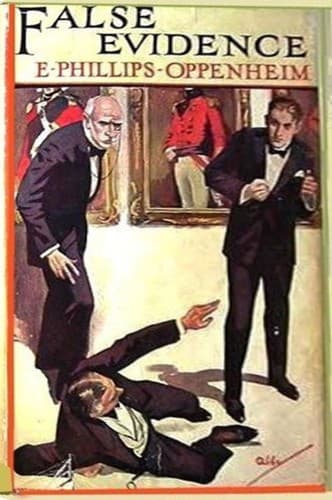
False EvidenceOppenheim, E. Phillips (Edward Phillips)
General
False Evidence
Oppenheim, E. Phillips (Edward Phillips)
Soldiers -- Fiction
"An unhappy man! Of course he is an unhappy man! He always will be!
Go and ask him what it is he desires. He will tell you a larger
fortune, or a peerage, or something of that sort. He is a fool--a
blind fool--not to have realised by this time that desires expand with
possessions, and the more the one increases the more ravenous the other
becomes. Bah! the principle is as simple as ABC. 'Tis the moralists
of the earth, be they Christians or Chinese, who win here! Logic and
philosophy may knock Christianity into a cocked hat. But Christianity
can make a man happy, which is exactly what philosophy won't do.
Happiness is internal, not external. It must sit in the heart, and not
float in the senses. And what gratification is there which a man can
get out of the good things of the world which can strike deeper than
the senses? Happiness is a consciousness; it is the consciousness of
goodness. Dreadfully common-place talk this, but common-placisms are
often truisms!"
I closed the book, and walked up and down the room restlessly. A great
bewilderment seemed to be closing in upon me. My faith in my father
was never really shaken, and yet this book seemed to me to ring with
evidences that it was written by a high-minded, naturally good man.
All my ideas were disarranged. A great wave of wondering doubt seemed
beating against the prejudice which had grown up in my heart against my
Uncle Rupert. At last I could bear it no longer. With the book still
in my hand I hurried out into the street. Within ten minutes I stood
before Rupert Devereux's house in Mayfair, and almost immediately was
ushered by the servant into his study.
He was bending close over his writing-desk with his back to me, writing
fast, and sheets of foolscap lay on the floor all around him. He had
not heard me announced, and he wrote on without looking up.
I stepped into the middle of the room and spoke to him:
"Rupert Devereux," I cried, "it is I, Herbert Devereux's son. Turn
round, for I have something to say to you."
He started to his feet, and turned an eager face towards me. Then he
advanced a step or two, half holding out his hand.
"Hugh, you have come to accept my offer. God grant that you have."
I shook my head. "I have come to ask a question of the man who wrote
this book," I answered, holding it out. "I have come to ask the man
who writes that happiness is the abstract product of a consciousness of
right doing, whether he is happy? Rupert Devereux, you know what
happiness is. Tell me, are you happy?"
He sank into a chair and covered his face with his hands. My heart
grew lighter as I looked upon him.
"They tell me that you are a successful man," I continued, mercilessly.
"You are a member of Parliament, and a noted one. You are spoken of as
a philanthropist, and a zealous one. You have written a book which any
man might be proud of having written. You are rich, you are well
spoken of everywhere. And you are a miserable man."
Public-domain text, read in full here on John Shaqi.
Reviews
Reviews
No reviews yet
Be the first to share your thoughts on this work.
Elsewhere in the archive
Join the Discussion
Join the discussion
Sign in to leave a comment or review.
Sign InorCreate an account