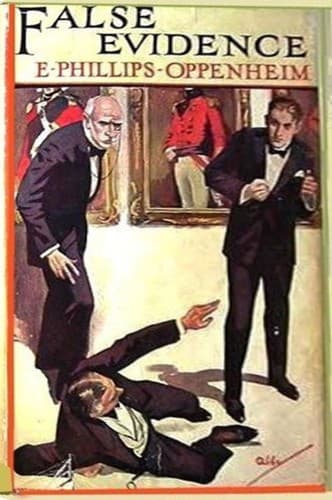
False EvidenceOppenheim, E. Phillips (Edward Phillips)
General
False Evidence
Oppenheim, E. Phillips (Edward Phillips)
Soldiers -- Fiction
I looked into his face, and shrunk back terrified. The passionate
hatred of a lifetime was convulsing and blackening his features, and
flashing fiercely from his blazing eyes.
"Let them," he muttered, "let them. A dog's death is fittest for him!"
One swift thought saved him. He was Maud's father. I hastened forward
and wrenched the rope from the hands of the men who were binding it
together.
"Monsieur José," I cried, "tell me for what you hang this man? What
has he done?"
"Killed two of my best comrades," was the prompt reply, "and by heaven
he shall swing for it."
The rope was wrenched from my hands and adjusted round Rupert
Devereux's neck. He was conscious now, but half dazed, and unable to
make any resistance. Seizing him by the collar, I released him from
the men's grasp, and dragged him with me to the side of the hill,
against which I set my back. They sprang after me, but started back
with a quick exclamation, for they looked into the black muzzle of my
father's revolver.
"You are right, Hugh," he cried, "I was mad! Monsieur José, listen to
me," he added quickly. "This man is an Englishman, and you know very
well what that means! To take his life would be to compass your own
extermination. He is a man of great position, and if you killed him,
sure as there is a heaven above us you would be hunted out and hanged,
every man of you."
"Who is to tell of his death?" José answered.
"I shall," was the firm reply. "And if you kill us, your fate is all
the surer, for we too are English, and it is known that we have come
here. Be sensible, José. Why kill him? What good will that do you?
Why not a ransom?"
The battle was won, but Monsieur José did not yield all at once.
"He has killed two of my best fellows," he said sullenly.
"What of that? It was done in fair fight, I suppose? He did not
attack them."
Monsieur José retired and consulted with his men. Presently he
reappeared, smiling.
"Monsieur Arbuthnot," he said, "we are anxious to oblige a friend whom
we value so much as you, but, at the same time, we feel the loss of two
such well-beloved comrades as Pintro and Salino deeply; so deeply, in
fact, that we cannot see our way to fix the ransom at less than two
thousand pounds English."
"They shall have it," groaned Rupert Devereux, lifting his head.
"Good! Where is the money to be got?" inquired José, with twinkling
eyes.
"There is as much in Rothschild's bank at Rome. Send one of your men
to Palermo with a telegram, and let him wait till the money is wired to
my credit. If you will give me something to write with, I will give
him authority to draw it."
It was done, and then, whilst José withdrew to consult with his
followers as to who should be the messenger, my Uncle Rupert turned
slowly round and looked into my father's face.
CHAPTER XXXVIII
AN OMINOUS NOTE
Public-domain text, read in full here on John Shaqi.
Reviews
Reviews
No reviews yet
Be the first to share your thoughts on this work.
Elsewhere in the archive
Join the Discussion
Join the discussion
Sign in to leave a comment or review.
Sign InorCreate an account