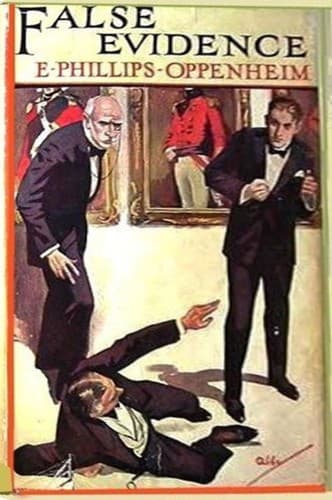
False EvidenceOppenheim, E. Phillips (Edward Phillips)
General
False Evidence
Oppenheim, E. Phillips (Edward Phillips)
Soldiers -- Fiction
"For twenty years, Hugh, I have been a lonely, unhappy man. Gradually
I began to lose all pride and interest in our family name, and even the
Court itself, every stone of which was once dear to me. Everything
that had made life endurable for me and pleasant had gone. My pride
in, and love for, my son who had gone away with my blessing to be where
a Devereux should always be, in his country's battles, was suddenly
blasted for ever. He disgraced our long line of ancestors, disgraced
himself and me, and instead of falling on his sword, as he should have
done, came home here, turned out of the army--a Devereux turned out of
the army, to beg for my forgiveness!"
My heart was burning, but I judged it wisest to hold my peace. He had
thrown his head back, and his eyes were sparkling with anger. His
frowning face was as stern and hard as marble, and, old man though he
was, he looked terrible.
For a moment there was silence, and then he went on--
"Enough of him! If it had been Rupert I might some day have forgiven
him. But Herbert, my eldest son, who at my death must be the head of
the Devereuxs--oh, it is a cursed, cruel thing!"
He turned his back upon me, and I heard a sort of gasping sob. I made
a pretence of stirring the fire, and when I had finished he was himself
again.
"For twenty years," he went on, "I have lived alone with a leaden
weight of misery dragging me down almost to the grave. And yet I have
struggled against death for the simple reason that the thought of that
disgraced man who was once my son calling himself the head of the
Devereuxs, and lying down to rest within the walls of Devereux Court,
has kept me hanging on to life. My son a coward! To run away from the
enemy! My God, what had I done to deserve this?"
"He was not a coward," I interrupted, passionately. "Rupert lied! I
know he lied! He was jealous! John Hilton has confessed to me!"
Sir Francis shook his head sorrowfully.
"The word of a servant discharged without a character is worth very
little, especially when it is directed against his master," he said.
"No, Hugh, my boy, if you had lived as long as I have, and had been a
soldier, you would know that a court-martial never errs. It never
convicts except on overwhelming evidence, and its judgments are
absolute. General Luxton came to see me when he returned to England,
and from him I learned the undoubted truth."
I remained silent. One might as well have talked to the Sphinx as to
this coldly obstinate, dogmatic old soldier.
Public-domain text, read in full here on John Shaqi.
Reviews
Reviews
No reviews yet
Be the first to share your thoughts on this work.
Elsewhere in the archive
Join the Discussion
Join the discussion
Sign in to leave a comment or review.
Sign InorCreate an account