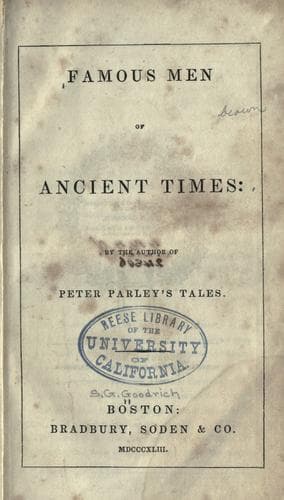
Famous Men of Ancient TimesGoodrich, Samuel G. (Samuel Griswold)
History
Famous Men of Ancient Times
Goodrich, Samuel G. (Samuel Griswold)
Biography -- Juvenile literature; Men -- Biography -- Juvenile literature
But the period of his return to Rome was now approaching. Clodius, by
a series of the most flagrant outrages, made himself hated at Rome,
and finally put himself in opposition to Pompey himself. The people at
large were favorable to Cicero, and it was not long before the senate,
with great unanimity, passed a resolution favorable to his recall.
Pompey urged the measure with ardor, and declared that Cicero ought to
be received with such honors, as might atone for the sorrows of his
exile.
Preparations were made to obtain the passage of a law coinciding
with the resolve of the senate; but Clodius, with his slaves and a
multitude of hired gladiators, resisted the tribunes who sought to
gain possession of the market-place, for that purpose. Several bloody
encounters followed, and for a time the streets of Rome were deluged
with blood. The dead bodies were thrown into the Tiber, which were so
numerous as almost to obstruct its channel. Nothing can better show
the greatness of Cicero’s reputation, than the facts now transpiring
in Rome. For several months the attention of the people of that city,
and of Italy, was wholly occupied with the question of his recall.
The ambassadors of kings, the messengers of princes,—affairs which
involved the fate of nations—were all laid aside, till this absorbing
subject could be disposed of.
The senate, after long deliberation, and in a full assembly, at last
passed a decree for his restoration; Clodius, among four hundred and
fifty, giving the only vote against it. When the news reached a
neighboring theatre, the air was rent with acclamation. Æsopus, the
actor, was performing, at the time, the part of Timolean, banished from
the country, in one of the plays of Accius. By a happy change of a
few words, and giving the utmost effect to his voice, he directed the
thoughts of the audience to Cicero, while he uttered these sentences,
“What, he who always stood up for the republic! who, in doubtful
times, spared neither life nor fortunes—the greatest friend in the
greatest dangers—of such parts and talents! O Father—I saw his house
and rich furniture all in flames! O, ungrateful Greeks, inconstant
people; forgetful of services,—to see such a man banished, driven
from his country, and suffer him to continue in this condition!” It
is not possible to describe the thrilling effect of these words, or
the enthusiasm of the people. When Lentulus, the consul, who had
taken an active part in Cicero’s favor, entered the place, they all
rose up, stretched out their hands, and, with tears of joy and loud
acclamations, testified their thanks. Several of the senators coming
into the theatre, were received with the most deafening applause.
Clodius also making his appearance was assailed by reproaches, threats
and curses.
Public-domain text, read in full here on John Shaqi.
Reviews
Reviews
No reviews yet
Be the first to share your thoughts on this work.
Elsewhere in the archive
Join the Discussion
Join the discussion
Sign in to leave a comment or review.
Sign InorCreate an account