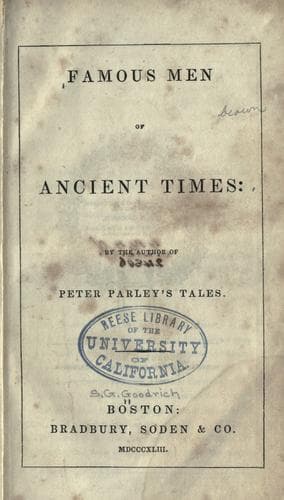
Famous Men of Ancient TimesGoodrich, Samuel G. (Samuel Griswold)
History
Famous Men of Ancient Times
Goodrich, Samuel G. (Samuel Griswold)
Biography -- Juvenile literature; Men -- Biography -- Juvenile literature
He left behind him an account of his battles, written from day to day,
as events occurred. These are called Commentaries, and furnish a fund
of authentic narrative for history, beside being admired for their
elegance of style. It was after a victory over Pharnaces, king of
Pontus, in Asia Minor, that he used the remarkable words, _veni, vidi,
vinci_—“I came, I saw, I conquered.” They well express the celerity
and decision of his movements. In private affairs he was extravagant of
money; his debts at one time amounted to eight hundred talents—almost
a million of dollars. These were paid by his friends. In public
concerns he did not appear greedy of wealth. As an evidence of the
activity and energy of his faculties, it was said that at the same time
he could employ his ear to listen, his eye to read, his hand to write,
and his mind to dictate. His disposition led him irresistibly to seek
dominion; in battle, he must be a conqueror; in a republic, he must be
the master. This leading feature in his character is well illustrated,
in his saying to the inhabitants of a village, “I would rather be first
here, than second in Rome.” His character is delineated by an eminent
writer, in the following terms:—
“Such was the affection of his soldiers, and their attachment to his
person, that they, who, under other commanders, were nothing above the
common rate of men, became invincible when Cæsar’s glory was concerned,
and met the most dreadful dangers with a courage which nothing could
resist.
“This courage, and this great ambition, were cultivated and cherished,
in the first place, by the generous manner in which Cæsar rewarded his
troops, and the honors which he paid them. His whole conduct showed
that he did not accumulate riches to minister to luxury, or to serve
any pleasures of his own, but that he laid them up in a common stock,
as prizes to be obtained by distinguished valor; and that he considered
himself no farther rich, than as he was in a condition to do justice to
the merit of his soldiers. Another thing that contributed to make them
invincible, was their seeing Cæsar always take his share in the danger,
and never desire any exemption from labor and fatigue.
“As for his exposing his person to danger, they were not surprised at
it, because they knew his passion for glory; but they were astonished
at his patience under toil, so far, in all appearance, above his
bodily powers; for he was of a slender make, fair, of a delicate
constitution, and subject to violent headaches, and epileptic fits. He
had the first attack of the falling sickness at Corduba. He did not,
however, make these disorders a pretence for indulging himself. On the
contrary, he sought in war a remedy for his infirmities, endeavoring
to strengthen his constitution by long marches, by simple diet, by
seldom coming under cover. Thus he contended against his distemper, and
fortified himself against its attacks.
Public-domain text, read in full here on John Shaqi.
Reviews
Reviews
No reviews yet
Be the first to share your thoughts on this work.
Elsewhere in the archive
Join the Discussion
Join the discussion
Sign in to leave a comment or review.
Sign InorCreate an account