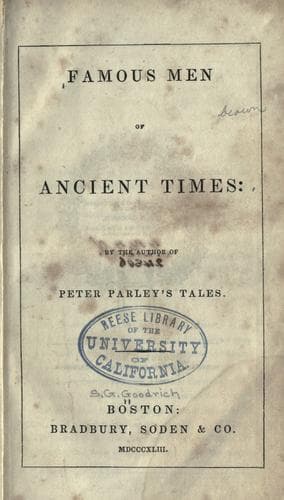
Famous Men of Ancient TimesGoodrich, Samuel G. (Samuel Griswold)
History
Famous Men of Ancient Times
Goodrich, Samuel G. (Samuel Griswold)
Biography -- Juvenile literature; Men -- Biography -- Juvenile literature
Everything seemed to show that Alexander had very early acted under
the idea of being a king, and of pursuing, in that character, a career
of conquest. No doubt all around him, the courtiers, his father and
mother, and his teachers had thus trained him, and no doubt all this
coincided with his natural turn of mind. He not only showed personal
courage, but a precocious desire of practical knowledge. When less than
twelve years of age, ambassadors came to visit the court of Macedon
from Persia. Philip was absent, and Alexander therefore received them
with great politeness, and a sobriety quite astonishing. He asked no
trifling or childish questions; but made a great many inquiries about
the roads to Persia; the distance from place to place; the situation
of certain provinces; the character of their king; how he treated his
enemies; in what the power of Persia lay, &c. All this astonished
the ambassadors, who, in their excitement, exclaimed, “The boasted
sagacity of Philip is nothing to the lofty and enterprising genius of
his son!” Such, indeed, were the striking qualities of young Alexander,
that the people of Macedon, in their admiration, called the youth king,
and his father only general!
Philip was pleased with all this, but as Alexander grew older, troubles
sprung up between them. Olympias, the mother of Alexander, was a woman
of fierce and restive temper, and she was justly incensed by a foolish
marriage which Philip made with a young lady, named Cleopatra. At the
celebration of this union there was great festivity, and the king got
drunk. Alexander’s mind, having been poisoned by his mother, was in
such a state of irritation, that he spoke rudely at the feast. Philip
drew his sword, but his passion and the wine he had drunk, caused
him to stumble, and he fell upon the floor. “See,” said Alexander,
insolently—“men of Macedon, see there the man who was preparing to
pass from Europe into Asia! He is not able to pass from one table to
another!” After this insult, he left the table, and taking his mother,
they repaired to Epirus.
Here they spent some time, but Philip at last induced them to come
back. Other troubles, however, arose, and finally king Philip was slain
by Pausanius, whom he had injured. Olympias was thought to have incited
the young man to this desperate act, and suspicion of participation
fell upon Alexander.
Public-domain text, read in full here on John Shaqi.
Reviews
Reviews
No reviews yet
Be the first to share your thoughts on this work.
Elsewhere in the archive
Join the Discussion
Join the discussion
Sign in to leave a comment or review.
Sign InorCreate an account