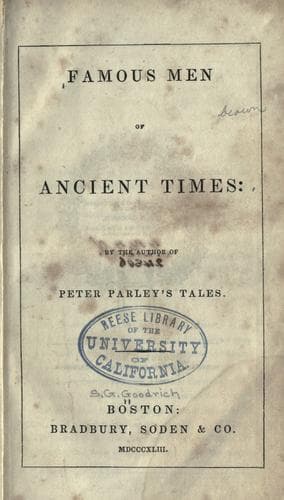
Famous Men of Ancient TimesGoodrich, Samuel G. (Samuel Griswold)
History
Famous Men of Ancient Times
Goodrich, Samuel G. (Samuel Griswold)
Biography -- Juvenile literature; Men -- Biography -- Juvenile literature
In the midst of the horrors which took place immediately after Thebes
was taken—fire and the sword, slaughter, rapine, violence, raging on
all sides—a party of savage Thracians, belonging to Alexander’s army,
demolished the house of Timoclea, a woman of high standing and quality.
Having carried off the booty found in her house, and shamefully abused
the lady, the captain asked her if she had not some gold and silver
concealed. She replied that she had—and taking him alone into the
garden, showed him a well, in which she said she had thrown everything
of value when the city was taken. The officer stooped to look into
the well, when the lady pushed him down, and rolling stones down
upon him, soon despatched him. The Thracians, coming up, found what
she had done, and, binding her hands, took her to Alexander. When he
asked her who she was—“A sister of Theagenes,” said she, proudly and
fearlessly,—“a Theban general, who fought for the liberty of Greece,
against the usurpation of Philip—and fell gloriously at the battle of
Cheronæa!” Alexander was so much struck by her noble mien and patriotic
sentiments, that he caused her and her children to be set at liberty.
Such are the few rays of light, that flash across the dark path of the
conqueror!
Greece was soon brought to a state of submission and, as Alexander now
contemplated an expedition against Darius, king of Persia, the several
states, having held an assembly at Corinth, concluded to furnish their
quota of supplies. Many statesmen and philosophers came to Corinth,
where Alexander was to congratulate him upon this result; but the king
was disappointed to find that Diogenes, the cynic philosopher, was not
among the number. As he desired greatly to see him, he went to his
residence in the suburbs of the city, to pay him a visit. He found the
philosopher, basking in the sun; at the approach of so many people, he
carelessly roused himself a little, and happened to fix his eyes on
Alexander—“Is there anything,” said the king, condescendingly—“in
which I can serve you?”—“Only stand a little out of my sunshine,” said
Diogenes. This answer produced a laugh among the crowd, who thought it
mere vulgarity; but Alexander saw deeper, and, reflecting upon that
superiority, which could regard even his presence without surprise,
and look with disdain upon his gifts, remarked, “that if he were not
Alexander, he would wish to be Diogenes.”
Public-domain text, read in full here on John Shaqi.
Reviews
Reviews
No reviews yet
Be the first to share your thoughts on this work.
Elsewhere in the archive
Join the Discussion
Join the discussion
Sign in to leave a comment or review.
Sign InorCreate an account