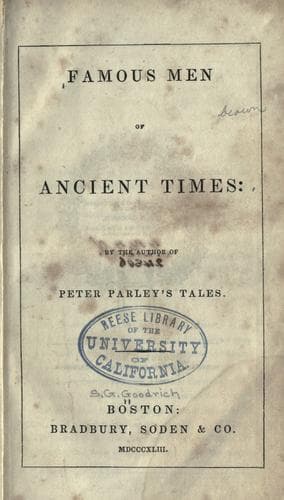
Famous Men of Ancient TimesGoodrich, Samuel G. (Samuel Griswold)
History
Famous Men of Ancient Times
Goodrich, Samuel G. (Samuel Griswold)
Biography -- Juvenile literature; Men -- Biography -- Juvenile literature
Alexander was now declared king of all Asia, and, though this might
seem the summit of his glory, it was the point at which his character
begins to decline. He now affected the pomp of an eastern prince, and
addicted himself to dissipation. He, however, continued his conquests.
He marched to Babylon, which opened its gates for his reception. He
proceeded to Persepolis, which he took by surprise. Here, in a drunken
frolic, and instigated by an abandoned woman, named Thais, he set fire
to the palace, which was burnt to the ground.
He now marched into Parthia, and, meeting with a beautiful princess,
named Roxana, daughter of a Bactrian king, he fell in love with her,
and married her. Some time after this, upon some suspicion of the
fidelity of Philotas, the son of Parmenio, he caused him to be put
to the torture till he died. He then sent orders to have his father,
an old and faithful soldier, who had fought under Philip, and who
was now in Media, to be put to death, which were but too faithfully
executed. This horrid transaction was soon followed by another, still
more dreadful. Under the excitement of wine, a dispute arose between
Alexander and Clytus, the brave officer who had saved his life at the
battle of the Granicus.
Both became greatly excited: taunts and gibes were uttered on either
side. Alexander, unable longer to keep down his rage, threw an apple
in the face of Clytus, and then looked about for his sword; but one of
his friends had prudently taken it away. Clytus was now forced out of
the room, but he soon came back, and repeated the words of Euripides,
meaning to apply them to Alexander:
“Are these your customs?—Is it thus that Greece
Rewards her combatants? Shall one man claim
The trophies won by thousands?”
The conqueror was now wholly beside himself. He seized a spear from
one of the guards, and, at a plunge, ran it through the body of Clytus,
who fell dead, uttering a dismal groan as he expired.
Alexander’s rage subsided in a moment. Seeing his friends standing
around in silent astonishment, he hastily drew out the spear, and was
applying it to his own throat, when his guards seized him, and carried
him by force to his chamber. Here the pangs of remorse stung him to
the quick. Tears fell fast for a time, and then succeeded a moody,
melancholy silence, only broken by groans. His friends attempted in
vain to console him. It was not till after long and painful suffering,
that he was restored to his wonted composure.
Public-domain text, read in full here on John Shaqi.
Reviews
Reviews
No reviews yet
Be the first to share your thoughts on this work.
Elsewhere in the archive
Join the Discussion
Join the discussion
Sign in to leave a comment or review.
Sign InorCreate an account