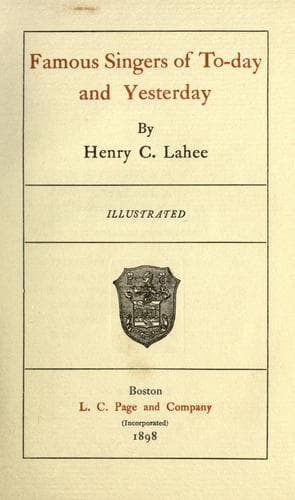
Famous Singers of To-day and YesterdayLahee, Henry Charles
History
Famous Singers of To-day and Yesterday
Lahee, Henry Charles
Singers
After a short honeymoon, a concert tour in the United States was
undertaken. Madame Nevada did not retire from the stage, but after
fifteen years she is still as popular as ever, though her voice is too
light to be effective in any of the grand operas of modern times.
Unquestionably the greatest artist of her school on the opera stage at
the present day is Emma Calve, whose proper name is Emma Roquer. She was
born in 1866, at Decazeville in the Aveyron, her father being a civil
engineer, and a member of a good Spanish family. He unfortunately died
when his daughter Emma was sixteen years of age, and left his family in
poor circumstances. Emma, who was the eldest child, was brought up in a
convent, the quiet life of which was very attractive to her, but she was
prevented from taking the veil because her mother needed her help at
home.
A gentleman from Paris, who heard her sing one day in the convent
chapel, urged her mother to send her to Paris for musical training, and
much against her own wishes the young singer began the course of
training which led to her appearance on the operatic stage.
Life has not been all sunshine for Emma Calve. She has acquired her art
in the school of adversity. Her early stage experiences were not highly
successful, though she was reengaged. Her debut was made at Brussels at
the Theatre de Monnaie, as Marguerite in "Faust," in 1881. During this
season she received a salary of a hundred and forty dollars a month,
which was increased the next year to two hundred and forty. In 1884 she
went to Paris, where she created the leading part in "Aben Hamet," by
Dubois, at the Theatre Italien, and was decidedly successful.
Her teachers up to this time had been a tenor named Puget, and Laborde,
but she now began to study under Madame Marchesi, and then followed a
successful tour in Italy, during which she gained much by association
with the Italian people, and cultivated her dramatic instincts. Here she
saw Eleanora Duse, the great actress, whose impersonations made a great
impression on the young singer. Calve's impassioned acting, her
magnetic personality, and beautiful voice, won for her the greatest
success at La Scala. In 1889 she returned to Paris, and continued her
career of hard work and success, but the day of her greatness had not
yet come.
In 1891 she created the part of Suzel in "L'Amico Fritz," at Rome, an
event which added greatly to her renown, and when "Cavalleria Rusticana"
was given in Paris for the first time in 1892, Calve was selected as the
most fitting interpreter of the part of Santuzza. Her success in this
part was something phenomenal, and was gained after much study of the
story, the close intercourse she had made with the Italian people, and
by the aid of some suggestions from Mascagni, the composer.
Public-domain text, read in full here on John Shaqi.
Reviews
Reviews
No reviews yet
Be the first to share your thoughts on this work.
Elsewhere in the archive
Join the Discussion
Join the discussion
Sign in to leave a comment or review.
Sign InorCreate an account