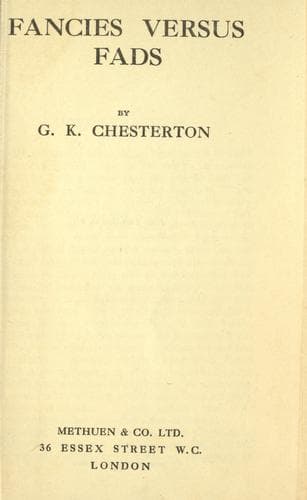
Fancies Versus FadsChesterton, G. K. (Gilbert Keith)
General
Fancies Versus Fads
Chesterton, G. K. (Gilbert Keith)
English essays -- 20th century
To explain what I mean I will take this parallel of the technique of
music, of which I know even less than of the technique of natural
history. To begin with a simple though moving musical instrument,
suppose an expert told me that a coach-horn could be blown quite as well
if it were only two feet long. I should believe him; partly because it
seems probable enough, and partly because I know nothing about the
matter. I am not even an incompetent coach-horn blower. But I should
certainly not believe him if he told me, as a generalization about all
musical instruments, that half a musical instrument was better than no
music, or even as good as any music. I should disbelieve it because it
is inconsistent with the general nature of a musical instrument, or any
instrument. I should disbelieve it long before I had thought of the
thousand particular instruments to which it does not apply. I should
not primarily need to think of the particular examples, though they are
obvious enough. A stringed instrument cannot even be called stringed
without two fixed points to hold both ends of the string. At the stage
when the fiddle-strings floated like filaments in the void, feeling
their way towards an evolutionary other end of nowhere, there could be
nothing serving any purpose of a fiddle. A drum with a hole in is not a
drum at all. But an evolutionary drum has to turn slowly into a drum,
when it has begun by being only a hole. I cannot see any survival for a
bagpipe that begins by being slit; I think such bagpipes would die with
all their music in them. I feel a faint doubt, mingled with fascination,
about the idea that a violin could grow out of the ground like a tree;
it would at least make a charming fairy story. But whether or no a
fiddle could grow like a tree, I feel sure nobody could play on it while
it was still only a twig. But all these, as I say, are only examples
that throng into the mind afterwards, of a principle seen in a flash
from the first. Of things serving particular purposes, by a balance and
arrangement of parts, it _cannot_ be generally true that they are fit
for use before they are finished for use. It is against the general
nature of such things; and can only be true by an individual
coincidence. I can see for myself, for instance, that some particular
case like the trunk of an elephant might really be compared to the
simpler case of the coach-horn. Length and flexibility _are_ mere
matters of degree; and I might possibly find it convenient if my nose
were six inches longer, and sufficiently lively to be able to point
right and left at various objects on the tea-table. But this is simply
an accident of the particular qualities of length and laxity, not a
general truth about the qualities of growth and use. It is not in the
least true that I should experience the least convenience from the
membrane between my fingers thickening or widening a little; even if an
evolutionist at my elbow comforted and inspired me with the far-off
Public-domain text, read in full here on John Shaqi.
Reviews
Reviews
No reviews yet
Be the first to share your thoughts on this work.
Elsewhere in the archive
Join the Discussion
Join the discussion
Sign in to leave a comment or review.
Sign InorCreate an account