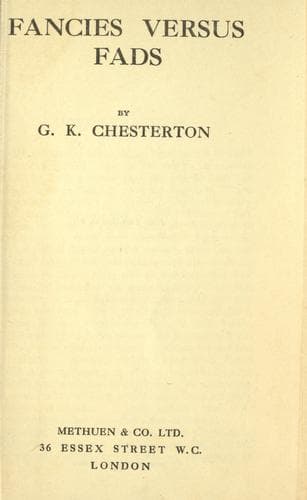
Fancies Versus FadsChesterton, G. K. (Gilbert Keith)
General
Fancies Versus Fads
Chesterton, G. K. (Gilbert Keith)
English essays -- 20th century
There is another answer often made which seems to me even more
illogical. The critic generally says it is unreasonable to expect from
the geological record that continuous gradation of types which the
challengers of Darwinism demand. He says that only a part of the earth
can be examined and that it could not in any case prove so much. This
mode of argument involves an amazing oblivion of what is the thing to be
proved, and who is trying to prove it. By hypothesis the Darwinians are
trying to prove Darwinism. The Anti-Darwinians are not trying to prove
anything; except that the Darwinians have not proved it. I do not demand
anything, in the sense of complaining anything or the absence of
anything. I am quite comfortable in a completely mysterious cosmos. I am
not reviling the rocks or cursing the eternal hills for not containing
these things. I am only saying that these are the things they would have
to contain to make me believe something that somebody else wants me to
believe. These traces are not things that the Anti-Darwinian demands.
They are things that the Darwinian requires. The Darwinian requires them
in order to convince his opponent of Darwinism; his opponent may be
right or wrong, but he cannot be expected to accept the mere absence of
them as proof of Darwinism. If the evidences in support of the theory
are unfortunately hidden, why then we do not know whether they were in
support of the theory. If the proofs of natural selection are lost, why
then there are no proofs of natural selection; and there is an end of
it.
And I would respectfully ask these critics what would be thought of a
theological or miraculous argument which thus based itself on the very
gaps in its own evidence. Let them indulge in the flight of fancy that I
have just told them, let us say, that I saw the Devil at Brighton: and
that the proof of his presence there can still be seen on the sands, in
gigantic marks of a cloven hoof as big as the foot of an elephant.
Suppose we all search the sands of Brighton and find no such thing. And
suppose I then say that, after all, the tide might have washed away the
footprints, or that the fiend may have flown through the air from his
little country seat at the Dyke, or that he may have walked along the
hard asphalt of Brighton parade, as proudly as once upon the flaming
marl. To those acquainted with Brighton parade this will seem probable
enough; but there would be a fallacy in merely saying that the evil
spirit may have done all this. The sceptic will not unnaturally reply:
“Yes, he may; and he may not; and it may be a legend; and you may be a
liar; and I think our little investigation is now concluded.” I am very
far indeed from calling the Darwinian a liar; but I shall continue to
say that he is not always a logician.
Turning Inside Out
Public-domain text, read in full here on John Shaqi.
Reviews
Reviews
No reviews yet
Be the first to share your thoughts on this work.
Elsewhere in the archive
Join the Discussion
Join the discussion
Sign in to leave a comment or review.
Sign InorCreate an account