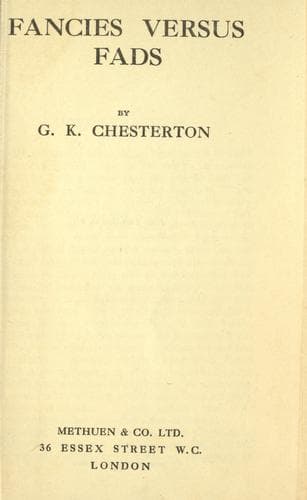
Fancies Versus FadsChesterton, G. K. (Gilbert Keith)
General
Fancies Versus Fads
Chesterton, G. K. (Gilbert Keith)
English essays -- 20th century
But in the problem of private versus public life there is another
neglected truth. It is true of many masculine problems as well as of
this feminine problem. Indeed, feminism falls here into exactly the same
mistake as militarism and imperialism. I mean that anything on a grand
scale gives the illusion of a grand success. Curiously enough,
multiplication acts as a concealment. Repetition actually disguises
failure. Take a particular man, and tell him to put on a particular kind
of hat and coat and trousers, and to stand in particular attitudes in
the back garden; and you will have great difficulty in persuading
yourself (or him) that he has passed through a triumph and
transfiguration. Order four hundred such hats, and eight hundred such
trousers, and you will have turned the fancy costume into a uniform.
Make all the four hundred men stand in the special attitudes on
Salisbury Plain, and there will rise up before you the spirit of a
regiment. Let the regiment march past, and, if you have any life in you
above the brutes that perish, you will have an overwhelming sense that
something splendid has just happened, or is just going to begin. I
sympathize with this moral emotion in militarism; I think it does
symbolize something great in the soul, which has given us the image of
St. Michael. But I also realize that in practical relations that emotion
can get mixed up with an illusion. It is not really possible to know the
characters of all the four hundred men in the marching column as well as
one might know the character of the one man attitudinizing in the back
garden. If all the four hundred men were individual failures, we could
still vaguely feel that the whole thing was a success. If we know the
one man to be a failure, we cannot think him a success.
Public-domain text, read in full here on John Shaqi.
Reviews
Reviews
No reviews yet
Be the first to share your thoughts on this work.
Elsewhere in the archive
Join the Discussion
Join the discussion
Sign in to leave a comment or review.
Sign InorCreate an account