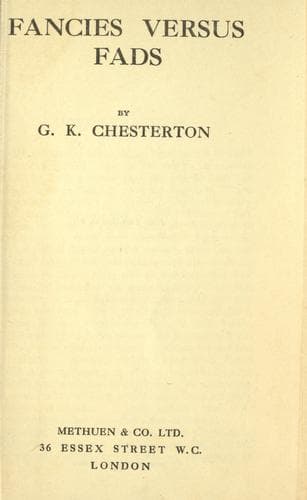
Fancies Versus FadsChesterton, G. K. (Gilbert Keith)
General
Fancies Versus Fads
Chesterton, G. K. (Gilbert Keith)
English essays -- 20th century
nerves of his own body, or the circulation of his own blood. That is a
much worse nightmare, and at this moment a much commoner one.
Tennyson struck a true note of the nineteenth century when he talked
about “the fairy-tales of science and the long result of time.” The
Victorians had a very real and even childlike wonder at things like the
steam-engine or the telephone, considered as toys. Unfortunately the
long result of time, on the fairy-tales of science, has been to extend
the science and lessen the fairy-tale, that is, the sense of the
fairy-tale. Take for example the case of a strike on the Tubes. Suppose
that at an age of innocence you had met a strange man who had promised
to drive you by the force of the lightning through the bowels of the
earth. Suppose he had offered, in a friendly way, to throw you from one
end of London to the other, not only like a thunderbolt, but by the same
force as a thunderbolt. Or if we picture it a pneumatic and not an
electric railway; suppose he gaily promised to blow you through a
pea-shooter to the other side of London Bridge. Suppose he indicated all
these fascinating opportunities by pointing to a hole in the ground and
telling you he would take you there in a sort of flying or falling room.
I hope you would have agreed that there was a special providence in a
falling room. But whether or no you could call it providential, you
would agree to call it special. You would at least think that the
strange man was a very strange man. You would perhaps call him a very
strange and special liar, if he merely undertook to do it. You might
even call him a magician, if he did do it. But the point is this, that
you would not call him a Bolshevik merely because he did not do it. You
would think it a wonderful thing that it should be done at all; passing
in that swift car through those secret caverns, you would feel yourself
whirled away like Cinderella carried off in the coach that had once been
a pumpkin. But though such things happened in every fairy-tale, they
were not expected in any fairy-tale. Nobody turned on the fairies and
complained that they were not working, because they were not always
working wonders. The press in those parts did not break into big
headlines of “Pumpkins Held Up; No Transformation Scenes,” or “Wands
Won’t Work; Famine of Coaches.” They did not announce with horror a
“Strike of Fairy Godmothers.” They did not draw panic-stricken pictures
of mobs of fairy godmothers, meeting in parks and squares, merely
because the majority of pumpkins still continued to be pumpkins. Now I
do not argue that we ought to treat every tube-girl as our fairy
godmother; she might resent the familiarity, especially the suggestion
of anything so near to a grandmother. But I do suggest that we should,
by a return to earlier sentiments, realize that the tube servants are
doing something for us that we could not do for ourselves; something
that is no part of our natural capacities, or even of our natural
rights.
Public-domain text, read in full here on John Shaqi.
Reviews
Reviews
No reviews yet
Be the first to share your thoughts on this work.
Elsewhere in the archive
Join the Discussion
Join the discussion
Sign in to leave a comment or review.
Sign InorCreate an account