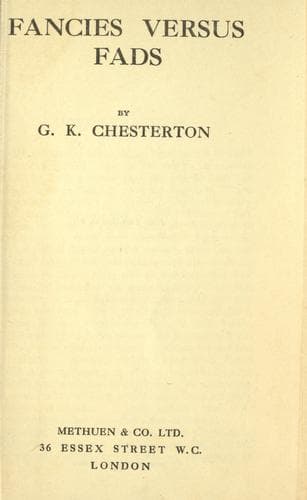
Fancies Versus FadsChesterton, G. K. (Gilbert Keith)
General
Fancies Versus Fads
Chesterton, G. K. (Gilbert Keith)
English essays -- 20th century
The butterfly becomes a burden and
the green carnation flourishes like the green bay-tree. For the moment I
do believe in “art for art’s sake.” And that name is John Milton.
It does really seem to me that Milton was an artist, and nothing but an
artist; and yet so great an artist as to sustain by his own strength the
idea that art can exist alone. He seems to me an almost solitary example
of a man of magnificent genius whose greatness does not depend at all
upon moral earnestness, or upon anything connected with morality. His
greatness is in a style, and a style which seems to me rather unusually
separate from its substance. What is the exact nature of the pleasure
which I, for one, take in reading and repeating some such lines, for
instance, as those familiar ones:
Dying put on the weeds of Dominic
Or in Franciscan think to pass disguised.
So far as I can see, the whole effect is in a certain unexpected order
and arrangement of words, independent and distinguished, like the
perfect manners of an eccentric gentleman. Say instead “Put on in death
the weeds of Dominic,” and the whole unique dignity of the line has
broken down. It is something in the quiet but confident inversion of
“Dying put on” which exactly achieves that perpetual slight novelty
which Aristotle profoundly said was the language of poetry. The idea
itself is at best an obvious and even conventional condemnation of
superstition, and in the ultimate sense a rather superficial one. Coming
where it does, indeed, it does not so much suggest moral earnestness as
rather a moralizing priggishness. For it is dragged in very laboriously
into the very last place where it is wanted, before a splendidly large
and luminous vision of the world newly created, and the first innocence
of earth and sky. It is that passage in which the wanderer through space
approaches Eden; one of the most unquestionable triumphs of all human
literature. That one book at least of “Paradise Lost” could claim the
more audacious title of “Paradise Found.” But if it was necessary for
the poet going to Eden to pass through Limbo, why was it necessary to
pass through Lambeth and Little Bethel? Why should he go there viâ Rome
and Geneva? Why was it necessary to compare the débris of Limbo to the
details of ecclesiastical quarrels in the seventeenth century, when he
was moving in a world before the dawn of all the centuries, or the
shadow of the first quarrel? Why did he talk as if the Church was
reformed before the world was made, or as if Latimer lit his candle
before God made the sun and moon? Matthew Arnold made fun of those who
claimed divine sanction for episcopacy by suggesting that when God said
“Let there be light,” He also said “Let there be Bishops.” But his own
favourite Milton went very near suggesting that when God said “Let there
be light,” He soon afterwards remarked “Let there be Nonconformists.” I
do not feel this merely because my own religious sympathies happen to be
Public-domain text, read in full here on John Shaqi.
Reviews
Reviews
No reviews yet
Be the first to share your thoughts on this work.
Elsewhere in the archive
Join the Discussion
Join the discussion
Sign in to leave a comment or review.
Sign InorCreate an account