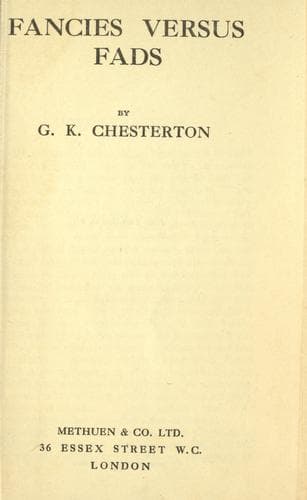
Fancies Versus FadsChesterton, G. K. (Gilbert Keith)
General
Fancies Versus Fads
Chesterton, G. K. (Gilbert Keith)
English essays -- 20th century
Now in the age of Milton there was a riot of religious poetry. Most of
it had moral earnestness, and much of it had splendid spiritual
conviction. But most of it was not the poetry of the Puritans; on the
contrary, it was mostly the poetry of the Cavaliers. The most real
religion--we might say the most realistic religion--is not to be found
in Milton, but in Vaughan, in Treherne, in Crashaw, in Herbert, and even
in Herrick. The best proof of it is that the religion is alive to-day,
as religion and not merely as literature. A Roman Catholic can read
Crashaw, an Anglo-Catholic can read Herbert, in a direct devotional
spirit; I gravely doubt whether many modern Congregationalists read the
theology of “Paradise Lost” in that spirit. For the moment I mention
only this purely religious emotion; I do not deny that Milton’s poetry,
like all great poetry, can awaken other great emotions. For instance, a
man bereaved by one of the tragedies of the Great War might well find a
stoical serenity in the great lines beginning “Nothing is here for
tears.” That sort of consolation is uttered, as nobly as it could be
uttered, by Milton; but it might be uttered by Sophocles or Goethe, or
even by Lucretius or Voltaire. But supposing that a man were seeking a
more Christian kind of consolation, he would not find it in Milton at
all, as he would find it in the lines beginning “They are all gone into
the world of light.” The whole of the two great Puritan epics do not
contain all that is said in saying “O holy hope and high humility.”
Neither hope nor humility were Puritan specialities.
But it was not only in devotional mysticism that these Cavaliers could
challenge the great Puritan; it was in a mysticism more humanistic and
even more modern. They shine with that white mystery of daylight which
many suppose to have dawned with Wordsworth and with Blake. In that
sense they make earth mystical where Milton only made heaven material.
Nor are they inferior in philosophic freedom; the single line of
Crashaw, addressed to a woman, “By thy large draughts of intellectual
day,” is less likely, I fancy, to have been addressed by Adam to Eve, or
by Milton to Mrs. Milton. It seems to me that these men were superior to
Milton in magnanimity, in chivalry, in joy of life, in the balance of
sanity and subtlety, in everything except the fact (not wholly remote
from literary criticism) that they did not write so well as he did. But
they wrote well enough to lift the load of materialism from the English
name; and show us the shining fields of a paradise that is not wholly
lost.
Public-domain text, read in full here on John Shaqi.
Reviews
Reviews
No reviews yet
Be the first to share your thoughts on this work.
Elsewhere in the archive
Join the Discussion
Join the discussion
Sign in to leave a comment or review.
Sign InorCreate an account