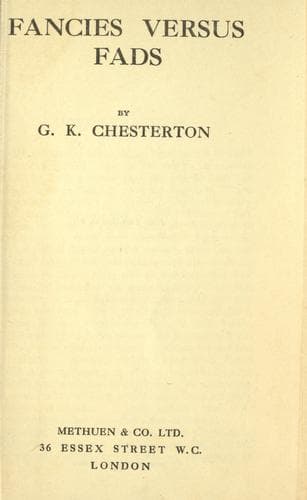
Fancies Versus FadsChesterton, G. K. (Gilbert Keith)
General
Fancies Versus Fads
Chesterton, G. K. (Gilbert Keith)
English essays -- 20th century
I will take only one example of what I mean by this purely literary
misunderstanding: an example from “Gulliver’s Travels” itself. The case
of the under-valuation of Swift is a particularly subtle one, for Swift
was really unbalanced as an individual, which has made it much easier
for critics not to keep the rather delicate balance of justice about
him. There is a superficial case for saying he was mad, apart from the
physical accident of his madness; but the point is that even those who
have realized that he was sometimes mad with rage have not realized
what he was in a rage with. And there is a curious illustration of this
in the conclusion of the story of Gulliver. Everyone remembers the ugly
business about the Yahoos, and the still uglier business about the real
human beings who reminded the returned traveller of Yahoos; how Gulliver
shrank at first from his friends, and would only gradually consent to
sit near his wife. And everybody remembers the picturesque but hostile
sketch which Thackeray gives of the satire and the satirist; of Swift as
the black and evil blasphemer sitting down to write his terrible
allegory, of which the only moral is that all things are, and always
must be, valueless and vile. I say that everybody remembers both these
literary passages; but, indeed, I fear that many remember the critical
who do not really remember the creative passage, and that many have read
Thackeray who have not read Swift.
Now it is here that purely literary criticism has a word to say. A man
of letters may be mad or sane in his cerebral constitution; he may be
right or wrong in his political antipathies; he may be anything we
happen to like or dislike from our own individual standpoint. But there
is one thing to which a man of letters has a right, whatever he is, and
that is a fair critical comprehension of any particular literary effect
which he obviously aims at and achieves. He has a right to his climax,
and a right not to be judged without reference to his climax. It would
not be fair to leave out the beautiful last lines of “Paradise Lost” as
mere bathos; without realizing that the poet had a fine intention in
allowing that conclusion, after all the thunder and the trumps of doom,
to fall and fade away on a milder note of mercy and reasonable hope. It
would not be fair to stigmatize the incident of Ignorance, damned at the
very doors of heaven at the end of Bunyan’s book, as a mere blot of
black Calvinist cruelty and spite, without realizing that the writer
fully intended its fearful irony, like a last touch of the finger of
fear. But this justice which is done to the Puritan masters of
imagination has hardly been done to the great Tory master of irony. No
critic I have read has noticed the real point and climax of that passage
about the Yahoos. Swift leads up to it ruthlessly enough, for an artist
of that sort is often ruthless; and it is increased by his natural
talent for a sort of mad reality of detail, as in his description of the
Public-domain text, read in full here on John Shaqi.
Reviews
Reviews
No reviews yet
Be the first to share your thoughts on this work.
Elsewhere in the archive
Join the Discussion
Join the discussion
Sign in to leave a comment or review.
Sign InorCreate an account