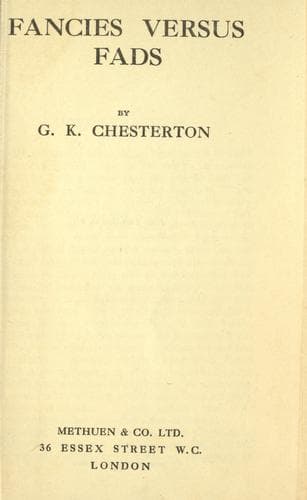
Fancies Versus FadsChesterton, G. K. (Gilbert Keith)
General
Fancies Versus Fads
Chesterton, G. K. (Gilbert Keith)
English essays -- 20th century
And the other men of the same tradition had essentially the same
instinct. Johnson was in many ways unjust to Swift, just as Cobbett was
afterwards unjust to Johnson. But looking back up the perspective of
history we can all see that those three great men were all facing the
same way; that they all regretted the rise of a rapacious and paganized
commercial aristocracy, and its conquest over the old popular
traditions, which some would call popular prejudices. When Johnson said
that the devil was the first Whig, he might have merely varied the
phrase by saying that he was the first aristocrat. For the men of this
Tory tradition, in spirit if not in definition, distinguished between
the privilege of monarchy and that of the new aristocracy by a very
tenable test. The mark of aristocracy is ambition. The king cannot be
ambitious. We might put it now by saying that monarchy is authority; but
in its essence aristocracy is always anarchy. But the men of that school
did not criticize the oligarch merely as a rebel against those above;
they were well aware of his activities as an oppressor of those below.
This aspect, as has already been noted, was best described by a friend
of Johnson, for whom Johnson had a very noble and rather unique
appreciation--Oliver Goldsmith.
A recent and sympathetic critic in the _Mercury_ used the phrase that
Mr. Belloc had been anticipated by Disraeli in his view of England as
having evolved into a Venetian oligarchy. The truth is that Disraeli was
anticipated by Bolingbroke and the many highly intelligent men who
agreed with him; and not least by Goldsmith. The whole view, including
the very parallel with Venice, can be found stated with luminous logic
and cogency in the “Vicar of Wakefield.” And Goldsmith attacked the
problem entirely from the popular side. Nobody can mistake his Toryism
for a snobbish submission to a privilege or title:
Princes and lords, the shadow of a shade,
A breath can make them, as a breath has made:
But a bold peasantry, a nation’s pride,
When once destroyed can never be supplied.
I hope he was wrong; but I sometimes have a horrible feeling that he may
have been right.
But I have here, thank God, no cause for touching upon modern politics.
I was educated, as much as my critic, in the belief that Whiggism was a
pure deliverance; and I hope I am still as willing as he to respect
Puritans for their individual virtue as well as for their individual
genius. But it moves all my memories of the unmorality of the ’nineties
to be charged with indifference to the importance of being earnest. And
it is for the sake of English literature that I protest against the
suggestion that we had no purity except Puritanism, or that only a man
like the author of “Paradise Lost” could manage to be on the side of the
angels.
* * * * *
Public-domain text, read in full here on John Shaqi.
Reviews
Reviews
No reviews yet
Be the first to share your thoughts on this work.
Elsewhere in the archive
Join the Discussion
Join the discussion
Sign in to leave a comment or review.
Sign InorCreate an account