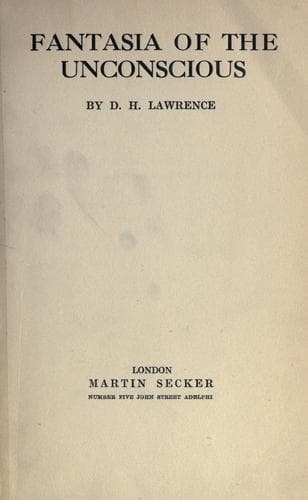
Fantasia of the UnconsciousLawrence, D. H. (David Herbert)
Philosophy
Fantasia of the Unconscious
Lawrence, D. H. (David Herbert)
Psychoanalysis; Sex; Subconsciousness
But no man ever had a wife unless he served a great predominant
purpose. Otherwise, he has a lover, a mistress. No matter how much she
may be married to him, unless his days have a living purpose,
constructive or destructive, but a purpose beyond her and all she
stands for; unless his days have this purpose, and his soul is really
committed to his purpose, she will not be a wife, she will be only a
mistress and he will be her lover.
If the man has no purpose for his days, then to the woman alone
remains the goal of her nights: the great sex goal. And this goal is
no goal, but always cries for the something beyond: for the rising in
the morning and the going forth beyond, the man disappearing ahead
into the distance of futurity, that which his purpose stands for, the
future. The sex goal needs, absolutely needs, this further departure.
And if there _be_ no further departure, no great way of belief on
ahead: and if sex is the starting point and the goal as well: then sex
becomes like the bottomless pit, insatiable. It demands at last the
departure into death, the only available beyond. Like Carmen, or like
Anna Karenina. When sex is the starting point and the returning point
both, then the only issue is death. Which is plain as a pike-staff in
"Carmen" or "Anna Karenina," and is the theme of almost _all_ modern
tragedy. Our one hackneyed, hackneyed theme. Ecstasies and agonies of
love, and final passion of death. Death is the only pure, beautiful
conclusion of a great passion. Lovers, pure lovers should say "Let it
be so."
And one is always tempted to say "Let it be so." But no, let it be not
so. Only I say this, let it be a great passion and then death, rather
than a false or faked purpose. Tolstoi said "No" to the passion and
the death conclusion. And then drew into the dreary issue of a false
conclusion. His books were better than his life. Better the woman's
goal, sex and death, than some _false_ goal of man's.
Better Anna Karenina and Vronsky a thousand times than Natasha and
that porpoise of a Pierre. This pretty, slightly sordid couple tried
so hard to kid themselves that the porpoise Pierre was puffing with
great purpose. Better Vronsky than Tolstoi himself, in my mind. Better
Vronsky's final statement: "As a soldier I am still some good. As a
man I am a ruin"--better that than Tolstoi and Tolstoi-ism and that
beastly peasant blouse the old man wore.
Better passion and death than any more of these "isms." No more of the
old purpose done up in aspic. Better passion and death.
But still--we _might_ live, mightn't we?
For heaven's sake answer plainly "No," if you feel like it. No good
temporizing.
EPILOGUE
"_Tutti i salmi finiscono in gloria._"
All the psalms wind up with the Gloria.--"As it was in the beginning,
is now, and ever shall be, World without end. Amen."
Well, then, Amen.
Public-domain text, read in full here on John Shaqi.
Reviews
Reviews
No reviews yet
Be the first to share your thoughts on this work.
Elsewhere in the archive
Join the Discussion
Join the discussion
Sign in to leave a comment or review.
Sign InorCreate an account