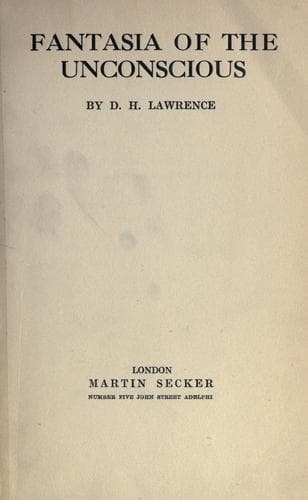
Fantasia of the UnconsciousLawrence, D. H. (David Herbert)
Philosophy
Fantasia of the Unconscious
Lawrence, D. H. (David Herbert)
Psychoanalysis; Sex; Subconsciousness
This is the question of all time. And as long as man and woman endure,
so will the answer be given, first one way, then the other. Man, as
the utterer, usually claims that Eve was created out of his spare rib:
from the field of the creative, upper dynamic consciousness, that is.
But woman, as soon as she gets a word in, points to the fact that man
inevitably, poor darling, is the issue of his mother's womb. So the
battle rages.
But some men always agree with the woman. Some men always yield to
woman the creative positivity. And in certain periods, such as the
present, the majority of men concur in regarding woman as the source
of life, the first term in creation: woman, the mother, the prime
being.
And then, the whole polarity shifts over. Man still remains the doer
and thinker. But he is so only in the service of emotional and
procreative woman. His highest moment is now the emotional moment when
he gives himself up to the woman, when he forms the perfect answer
for her great emotional and procreative asking. All his thinking, all
his activity in the world only contributes to this great moment, when
he is fulfilled in the emotional passion of the woman, the birth of
rebirth, as Whitman calls it. In his consummation in the emotional
passion of a woman, man is reborn, which is quite true.
And there is the point at which we all now stick. Life, thought, and
activity, all are devoted truly to the great end of Woman, wife and
mother.
Man has now entered on to his negative mode. Now, his consummation is
in feeling, not in action. Now, his activity is all of the domestic
order and all his thought goes to proving that nothing matters except
that birth shall continue and woman shall rock in the nest of this
globe like a bird who covers her eggs in some tall tree. Man is the
fetcher, the carrier, the sacrifice, the crucified, and the reborn of
woman.
This being so, the whole tendency of his nature changes. Instead of
being assertive and rather insentient, he becomes wavering and
sensitive. He begins to have as many feelings--nay, more than a woman.
His heroism is all in altruistic endurance. He worships pity and
tenderness and weakness, even in himself. In short, he takes on very
largely the original role of woman. Woman meanwhile becomes the
fearless, inwardly relentless, determined positive party. She grips
the responsibility. The hand that rocks the cradle rules the world.
Nay, she makes man discover that cradles should not be rocked, in
order that her hands may be left free. She is now a queen of the
earth, and inwardly a fearsome tyrant. She keeps pity and tenderness
emblazoned on her banners. But God help the man whom she pities.
Ultimately she tears him to bits.
Public-domain text, read in full here on John Shaqi.
Reviews
Reviews
No reviews yet
Be the first to share your thoughts on this work.
Elsewhere in the archive
Join the Discussion
Join the discussion
Sign in to leave a comment or review.
Sign InorCreate an account