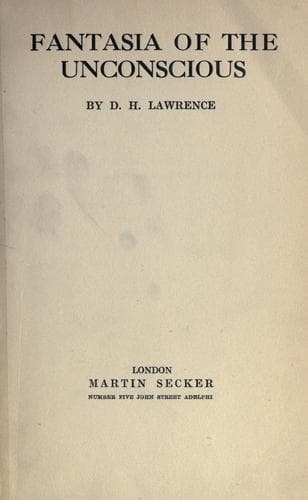
Fantasia of the UnconsciousLawrence, D. H. (David Herbert)
Philosophy
Fantasia of the Unconscious
Lawrence, D. H. (David Herbert)
Psychoanalysis; Sex; Subconsciousness
To make the mind the absolute ruler is as good as making a Cook's
tourist-interpreter a king and a god, because he can speak several
languages, and make an Arab understand that an Englishman wants fish
for supper. And to make an ideal a ruling principle is about as stupid
as if a bunch of travelers should never cease giving each other and
their dragoman sixpence, because the dragoman's main idea of virtue is
the virtue of sixpence-giving. In the same way, we _know_ we cannot
live purely by impulse. Neither can we live solely by tradition. We
must live by all three, ideal, impulse, and tradition, each in its
hour. But the real guide is the pure conscience, the voice of the self
in its wholeness, the Holy Ghost.
We have fallen now into the mistake of idealism. Man always falls into
one of the three mistakes. In China, it is tradition. And in the South
Seas, it seems to have been impulse. Ours is idealism. Each of the
three modes is a true life-mode. But any one, alone or dominant,
brings us to destruction. We must depend on the wholeness of our
being, ultimately only on that, which is our Holy Ghost within us.
Whereas, in an ideal of love and benevolence, we have tried to
automatize ourselves into little love-engines always stoked with the
sorrows or beauties of other people, so that we can get up steam of
charity or righteous wrath. A great trick is to pour on the fire the
oil of our indignation at somebody else's wickedness, and then, when
we've got up steam like hell, back the engine and run bish! smash!
against the belly of the offender. Because he said he didn't want to
love any more, we hate him for evermore, and try to run over him,
every bit of him, with our love-tanks. And all the time we yell at
him: "Will you deny love, you villain? Will you?" And by the time he
faintly squeaks, "I want to be loved! I want to be loved!" we have got
so used to running over him with our love-tanks that we don't feel in
a hurry to leave off.
"_Sois mon frere, ou je te tue._"
"_Sois mon frere, ou je me tue._"
There are the two parrot-threats of love, on which our loving
centuries have run as on a pair of railway-lines. Excuse me if I want
to get out of the train. Excuse me if I can't get up any love-steam
any more. My boilers are burst.
Public-domain text, read in full here on John Shaqi.
Reviews
Reviews
No reviews yet
Be the first to share your thoughts on this work.
Elsewhere in the archive
Join the Discussion
Join the discussion
Sign in to leave a comment or review.
Sign InorCreate an account