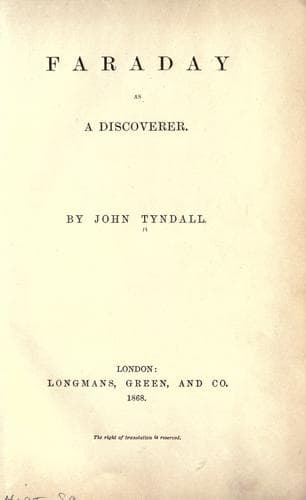
Faraday, Michael, 1791-1867; Physicists -- Great Britain -- Biography
With that admirable instinct which always guided him, Faraday had seen
that it was possible, if not probable, that the diamagnetic force acts
with different degrees of intensity in different directions, through
the mass of a crystal. In his studies on electricity, he had sought an
experimental reply to the question whether crystalline bodies had not
different specific inductive capacities in different directions, but
he failed to establish any difference of the kind. His first attempt
to establish differences of diamagnetic action in different directions
through bismuth, was also a failure; but he must have felt this to be
a point of cardinal importance, for he returned to the subject in 1850,
and proved that bismuth was repelled with different degrees of force in
different directions. It seemed as if the crystal were compounded of
two diamagnetic bodies of different strengths, the substance being more
strongly repelled across the magne-crystallic axis than along it. The
same result was obtained independently, and extended to various
other bodies, magnetic as well as diamagnetic, and also to compressed
substances, a little subsequently by myself.
The law of action in relation to this point is, that in diamagnetic
crystals, the line along which the repulsion is a maximum, sets
equatorially in the magnetic field; while in magnetic crystals the line
along which the attraction is a maximum sets from pole to pole. Faraday
had said that the magne-crystallic force was neither attraction nor
repulsion. Thus far he was right. It was neither taken singly, but it
was both. By the combination of the doctrine of diamagnetic polarity
with these differential attractions and repulsions, and by paying due
regard to the character of the magnetic field, every fact brought
to light in the domain of magne-crystallic action received complete
explanation. The most perplexing of those facts were shown to result
from the action of mechanical couples, which the proved polarity both
of magnetism and diamagnetism brought into play. Indeed the thoroughness
with which the experiments of Faraday were thus explained, is the most
striking possible demonstration of the marvellous precision with which
they were executed.
Footnotes to Chapter 11
[1] See Heat as a Mode of Motion, ninth edition, p. 75.
[2] See Sir Wm. Thomson on Magne-crystallic Action. Phil.
Mag., 1851.
Chapter 12.
Magnetism of flame and gases--atmospheric magnetism
Public-domain text, read in full here on John Shaqi.
Reviews
Reviews
No reviews yet
Be the first to share your thoughts on this work.
Join the Discussion
Join the discussion
Sign in to leave a comment or review.
Sign InorCreate an account