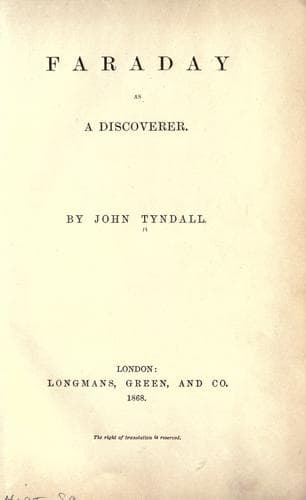
Faraday, Michael, 1791-1867; Physicists -- Great Britain -- Biography
When an experimental result was obtained by Faraday it was instantly
enlarged by his imagination. I am acquainted with no mind whose power
and suddenness of expansion at the touch of new physical truth could be
ranked with his. Sometimes I have compared the action of his experiments
on his mind to that of highly combustible matter thrown into a furnace;
every fresh entry of fact was accompanied by the immediate development
of light and heat. The light, which was intellectual, enabled him to see
far beyond the boundaries of the fact itself, and the heat, which was
emotional, urged him to the conquest of this newly-revealed domain. But
though the force of his imagination was enormous, he bridled it like a
mighty rider, and never permitted his intellect to be overthrown.
In virtue of the expansive power which his vivid imagination conferred
upon him, he rose from the smallest beginnings to the grandest ends.
Having heard from Zantedeschi that Bancalari had established the
magnetism of flame, he repeated the experiments and augmented the
results. He passed from flames to gases, examining and revealing their
magnetic and diamagnetic powers; and then he suddenly rose from his
bubbles of oxygen and nitrogen to the atmospheric envelope of the
earth itself, and its relations to the great question of terrestrial
magnetism. The rapidity with which these ever-augmenting thoughts
assumed the form of experiments is unparalleled. His power in this
respect is often best illustrated by his minor investigations, and,
perhaps, by none more strikingly than by his paper 'On the Diamagnetic
Condition of Flame and Gases,' published as a letter to Mr. Richard
Taylor, in the 'Philosophical Magazine' for December, 1847. After
verifying, varying, and expanding the results of Bancalari, he submitted
to examination heated air-currents, produced by platinum spirals placed
in the magnetic field, and raised to incandescence by electricity. He
then examined the magnetic deportment of gases generally. Almost all
of these gases are invisible; but he must, nevertheless, track them in
their unseen courses. He could not effect this by mingling smoke with
his gases, for the action of his magnet upon the smoke would have
troubled his conclusions. He, therefore, 'caught' his gases in tubes,
carried them out of the magnetic field, and made them reveal themselves
at a distance from the magnet.
Public-domain text, read in full here on John Shaqi.
Reviews
Reviews
No reviews yet
Be the first to share your thoughts on this work.
Join the Discussion
Join the discussion
Sign in to leave a comment or review.
Sign InorCreate an account