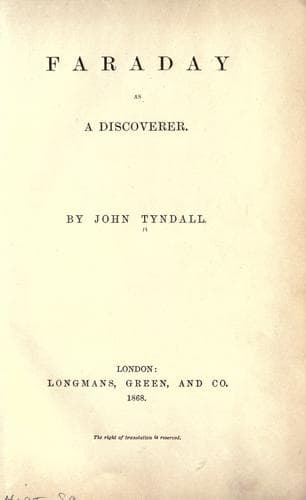
Faraday, Michael, 1791-1867; Physicists -- Great Britain -- Biography
He next labours to establish the true magnetic zero, a problem not so
easy as might at first sight be imagined. For the action of the magnet
upon any gas, while surrounded by air or any other gas, can only be
differential; and if the experiment were made in vacuo, the action of
the envelope, in this case necessarily of a certain thickness, would
trouble the result. While dealing with this subject, Faraday makes
some noteworthy observations regarding space. In reference to the
Torricellian vacuum, he says, 'Perhaps it is hardly necessary for me to
state that I find both iron and bismuth in such vacua perfectly obedient
to the magnet. From such experiments, and also from general observations
and knowledge, it seems manifest that the lines of magnetic force can
traverse pure space, just as gravitating force does, and as statical
electrical forces do, and therefore space has a magnetic relation of its
own, and one that we shall probably find hereafter to be of the utmost
importance in natural phenomena. But this character of space is not
of the same kind as that which, in relation to matter, we endeavour to
express by the terms magnetic and diamagnetic. To confuse these
together would be to confound space with matter, and to trouble all
the conceptions by which we endeavour to understand and work out a
progressively clearer view of the mode of action, and the laws of
natural forces. It would be as if in gravitation or electric forces,
one were to confound the particles acting on each other with the space
across which they are acting, and would, I think, shut the door to
advancement. Mere space cannot act as matter acts, even though the
utmost latitude be allowed to the hypothesis of an ether; and admitting
that hypothesis, it would be a large additional assumption to suppose
that the lines of magnetic force are vibrations carried on by it, whilst
as yet we have no proof that time is required for their propagation, or
in what respect they may, in general character, assimilate to or differ
from their respective lines of gravitating, luminiferous, or electric
forces.'
Public-domain text, read in full here on John Shaqi.
Reviews
Reviews
No reviews yet
Be the first to share your thoughts on this work.
Elsewhere in the archive
Join the Discussion
Join the discussion
Sign in to leave a comment or review.
Sign InorCreate an account