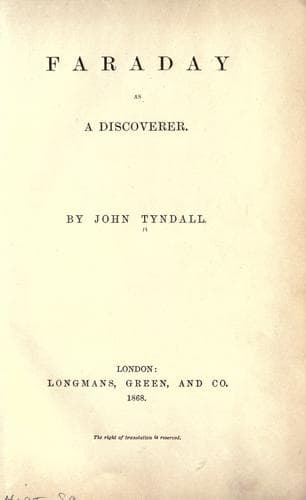
Faraday, Michael, 1791-1867; Physicists -- Great Britain -- Biography
Immersing one gas in another, he determined their differential action;
results of the utmost beauty being thus arrived at. Perhaps the
most important are those obtained with atmospheric air and its two
constituents. Oxygen, in various media, was strongly attracted by the
magnet; in coal-gas, for example, it was powerfully magnetic, whereas
nitrogen was diamagnetic. Some of the effects obtained with oxygen
in coal-gas were strikingly beautiful. When the fumes of chloride of
ammonium (a diamagnetic substance) were mingled with the oxygen, the
cloud of chloride behaved in a most singular manner,--'The attraction
of iron filings,' says Faraday, 'to a magnetic pole is not more striking
than the appearance presented by the oxygen under these circumstances.'
On observing this deportment the question immediately occurs to
him,--Can we not separate the oxygen of the atmosphere from its nitrogen
by magnetic analysis? It is the perpetual occurrence of such questions
that marks the great experimenter. The attempt to analyze atmospheric
air by magnetic force proved a failure, like the previous attempt to
influence crystallization by the magnet. The enormous comparative power
of the force of crystallization I have already assigned as a reason for
the incompetence of the magnet to determine molecular arrangement; in
the present instance the magnetic analysis is opposed by the force of
diffusion, which is also very strong comparatively. The same remark
applies to, and is illustrated by, another experiment subsequently
executed by Faraday. Water is diamagnetic, sulphate of iron is strongly
magnetic. He enclosed 'a dilute solution of sulphate of iron in a tube,
and placed the lower end of the tube between the poles of a powerful
horseshoe magnet for days together,' but he could produce 'no
concentration of the solution in the part near the magnet.' Here also
the diffusibility of the salt was too powerful for the force brought
against it.
The experiment last referred to is recorded in a paper presented to
the Royal Society on the 2nd August, 1850, in which he pursues the
investigation of the magnetism of gases. Newton's observations on
soap-bubbles were often referred to by Faraday. His delight in a
soap-bubble was like that of a boy, and he often introduced them into
his lectures, causing them, when filled with air, to float on invisible
seas of carbonic acid, and otherwise employing them as a means of
illustration. He now finds them exceedingly useful in his experiments
on the magnetic condition of gases. A bubble of air in a magnetic field
occupied by air was unaffected, save through the feeble repulsion of its
envelope. A bubble of nitrogen, on the contrary, was repelled from the
magnetic axis with a force far surpassing that of a bubble of air.
The deportment of oxygen in air 'was very impressive, the bubble being
pulled inward or towards the axial line, sharply and suddenly, as if the
oxygen were highly magnetic.'
Public-domain text, read in full here on John Shaqi.
Reviews
Reviews
No reviews yet
Be the first to share your thoughts on this work.
Elsewhere in the archive
Join the Discussion
Join the discussion
Sign in to leave a comment or review.
Sign InorCreate an account